A few label checks make choosing yarn much easier. Illustrative image. · Sunday Crochet
In this article
01 · A yarn label is your small project-planning guide02 · Step 1: Find the yarn weight category03 · Step 2: Read the yardage or meterage04 · Step 3: Check the fiber content05 · Step 4: Identify the crochet gauge box06 · Step 5: Use the hook suggestion as a starting point07 · Step 6: Read the whole care section08 · Step 7: Match the color and dye lot09 · Check the project instructions on the band, too10 · Common questionsA yarn label is your small project-planning guide
You find a yarn in a color you love, turn the ball over, and meet a row of tiny boxes and numbers. There is a weight category, a weight in grams, a length in meters, and something that looks like a miniature stitch chart. Which part should you check first?
Learning how to read a yarn label makes that decision much easier. The paper band tells you what the yarn is made of, how much you are buying, which tools the manufacturer suggests, and how to care for the finished fabric. It also helps you choose matching balls for a larger project.
I'll show you how I do this. I begin with the yarn's thickness, move down to its length and fiber content, then check the crochet gauge, care instructions, and dye lot. Each detail answers a different question. Reading them in that order gives you a practical way to compare the label with your pattern.
Step 1: Find the yarn weight category
Start with the small box that gives the yarn's weight category. On the ivory label below, it says super fine and shows the number 1. That number describes the thickness of the yarn strand.
Now look farther down the same band. You can also see 50 g. This is the mass of yarn in the ball, rather than its thickness. Both measurements use the word “weight,” which is why they are easy to confuse.
A 50 g ball can contain a fine strand or a thicker one. The grams tell you how much the ball weighs; the category tells you what kind of thickness you are working with. If your pattern specifies a yarn weight, compare it with the category first.
The crochet yarn weight guide explains how category numbers relate to familiar names such as DK and worsted. For reading this label, you only need to keep thickness separate from the quantity in the ball.
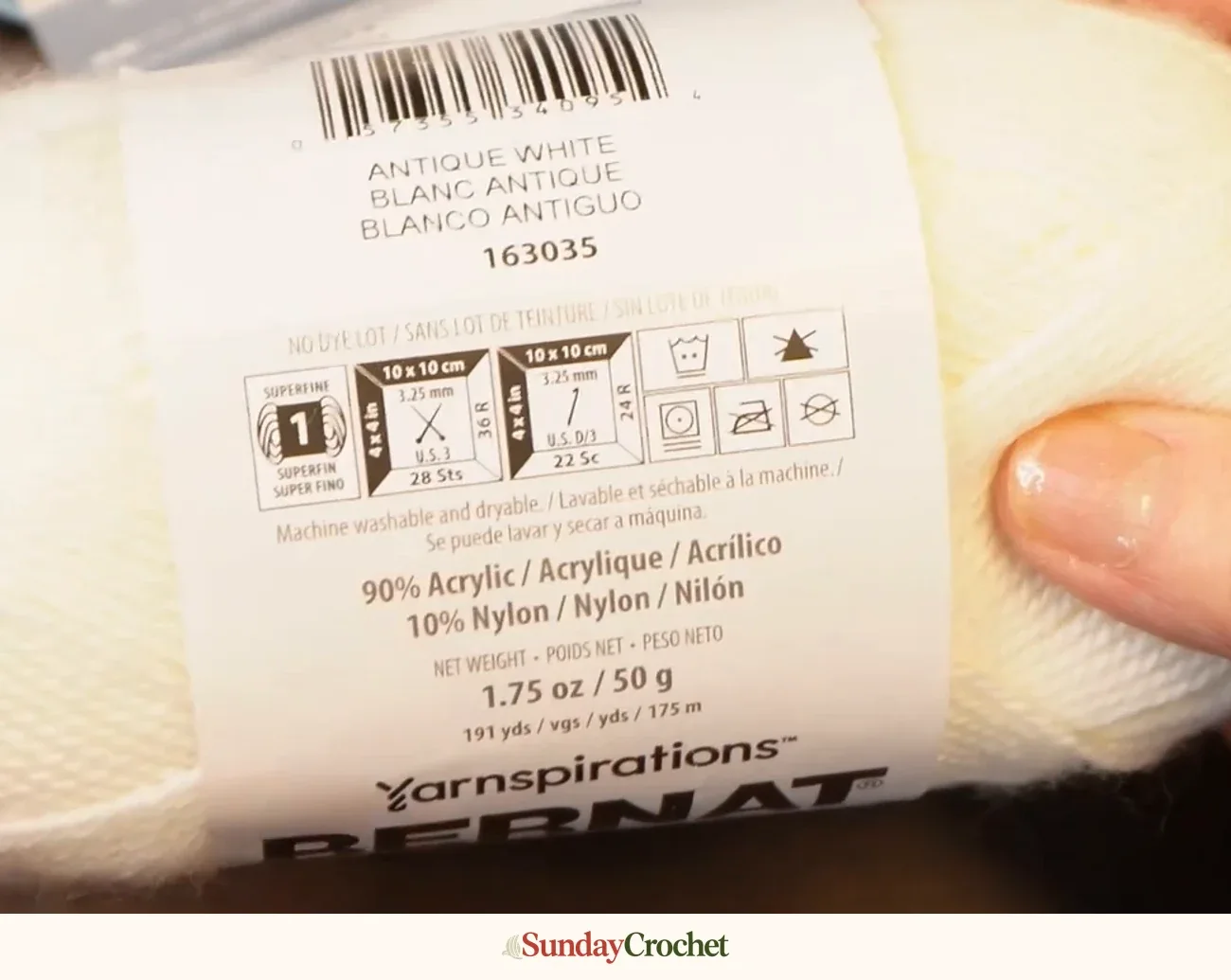
Notice how the category sits beside the gauge boxes, while grams and yardage appear below the fiber content. Labels vary in layout, so look for the units rather than expecting every manufacturer to place them in the same spot.
Step 2: Read the yardage or meterage
The ivory band lists 191 yards / 175 meters, along with 1.75 ounces / 50 grams. There are four numbers here, but only two measurements: length and mass.
Meters and yards tell you how long the strand is. Grams and ounces tell you how much it weighs. The paired figures express the same quantity in different units, with the printed values rounded. You do not add 191 yards to 175 meters; they describe the length inside one ball.
This is the part of the label that helps you turn a pattern's yarn requirement into a number of balls. Before calculating anything, check the unit in the pattern. If it asks for meters, use the meters on the band. If it asks for yards, use yards on both sides of the calculation.
Calculate how many balls you need
Suppose a project requires 600 meters and your chosen yarn contains 175 meters per ball.
- Divide the required length by the length in one ball: 600 ÷ 175 = approximately 3.43.
- Round up to the next whole ball. Three balls would give you only 525 meters.
- Choose four balls, giving you 700 meters in total.
The calculation is straightforward once the units match. It uses the amount specified for the project; it does not establish a yarn requirement for a project that has none.
You can also calculate from grams when the pattern specifies a mass for the same yarn. A 600 g requirement divided by 50 g per ball gives 12 balls. That is a different answer from the 600-meter example because the unit changes what the number means.
Pause over the units before buying. A quick check here is much easier than discovering halfway through a blanket that you calculated from the wrong line.
Step 3: Check the fiber content
Find the line that says what the yarn is made of. In the ivory example, the composition is 90% acrylic and 10% nylon. Read both percentages together to understand the blend.
The label repeats the fiber names in several languages. Those translations describe the same yarn; they are not extra ingredients. Once you have found the language you use, follow that line and the percentage underneath it.
Fiber content is a separate check from weight category. Two yarns can share a category while having different compositions. If you are comparing yarn for a pattern, read the fiber information as well as the strand thickness and the length per ball.
The blue yarn shown later has a different blend: 60% cotton and 40% acrylic. Its label also shows a different weight category. These details help you identify the two yarns without relying only on their colors or how large the balls look.
For a first crochet practice swatch, the band gives you a useful record of the yarn you chose. Keep it with the remaining ball so you can identify the same material when you pick the project up again.
Step 4: Identify the crochet gauge box
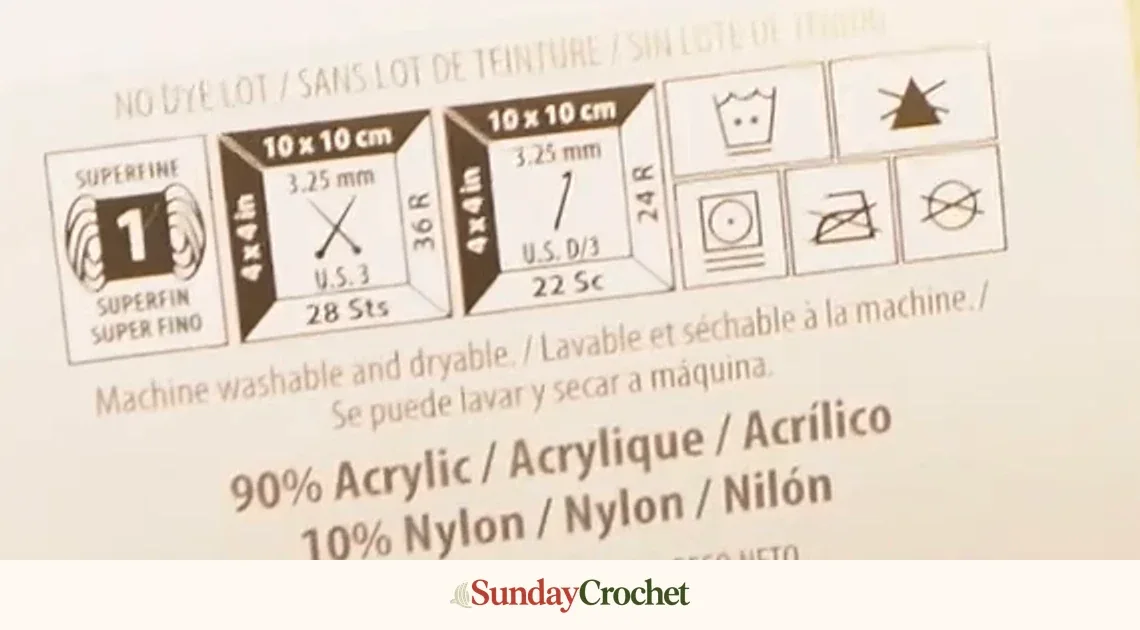
Now look at the pair of small boxes beside the weight category. One contains crossed knitting needles; the other contains a crochet hook. Identify the tool before reading the numbers around it.
On this label, both boxes suggest a 3.25 mm tool and a square measuring 10 × 10 cm, also shown as 4 × 4 inches. Their stitch and row counts are different because they describe different fabrics.
The knitting box gives 28 stitches and 36 rows, using stockinette stitch. The crochet box gives 22 single crochet stitches and 24 rows. For crochet, follow the box with the hook.
Read the crochet box from top to bottom
First, find the measurement area: the nominal 10 cm or 4-inch square. Next, read the suggested hook size. Then connect the stitch count across the bottom with the row count along the side.
Here, the information means that the manufacturer's reference gauge is 22 single crochets across and 24 rows high, over the stated area, using a 3.25 mm hook. “Single crochet” uses US stitch terminology in this example.
You are reading a reference gauge, rather than a complete set of instructions for your project. A pattern might use another stitch or require a different gauge. Understanding the stitch names in a written crochet pattern helps you make that comparison without mixing the two sets of numbers.
Step 5: Use the hook suggestion as a starting point
The label gives you a sensible hook size to begin with. This is useful when you are choosing a simple scarf or blanket and deciding on your own stitch pattern. Your tension still affects the size of the stitches you make.
With the 3.25 mm example, someone who crochets loosely might need a smaller hook, such as 3 mm, to approach the reference gauge. Someone who crochets tightly might need a larger hook, such as 3.5 or 3.75 mm.
Those sizes show the direction of the adjustment. They are not a guarantee that a particular replacement hook will produce the right measurement for everyone.
When you have a pattern, use its stated hook and gauge information to guide the project. Compare those instructions with the label instead of automatically replacing the pattern's figures with the ones on the ball band.
Also keep knitting needle numbers separate from crochet hook names. The crossed-needle box here shows US 3, while the hook box shows US D/3. The millimeter size helps you interpret the tool, but the symbol tells you which craft the recommendation belongs to.
Step 6: Read the whole care section
The care symbols sit beside the gauge boxes in the close-up. The written line underneath says the yarn is machine washable and dryable. The crossed-out iron and dry-cleaning circle indicate treatments this yarn should not receive.
Read the group as a whole. Permission to wash the yarn does not tell you everything about drying, ironing, or dry cleaning. Each treatment has its own instruction.
For this example, you can identify washing and drying information alongside the prohibitions on ironing and dry cleaning. That combination belongs to this yarn. It should not be applied automatically to every acrylic blend or every ball that looks similar.
If a symbol is unfamiliar, check its meaning before treating the finished item. The Craft Yarn Council's care-symbol reference explains the marks you may encounter. Follow the instructions on your chosen yarn rather than guessing a temperature or drying setting from its appearance.
It helps to check care while you are still choosing materials, particularly for an item that will need frequent washing. The band gives you that information before you invest time in making the fabric.
Step 7: Match the color and dye lot
Turn to the color information. On the blue labels below, the shade is Blue Waves, and the color number is 161269. Above the color name, both bands show 69025, their dye lot number.
The shade code identifies the color in the manufacturer's range. The dye lot identifies the batch in which the yarn was dyed. Those numbers serve different purposes, even though they are printed close together.
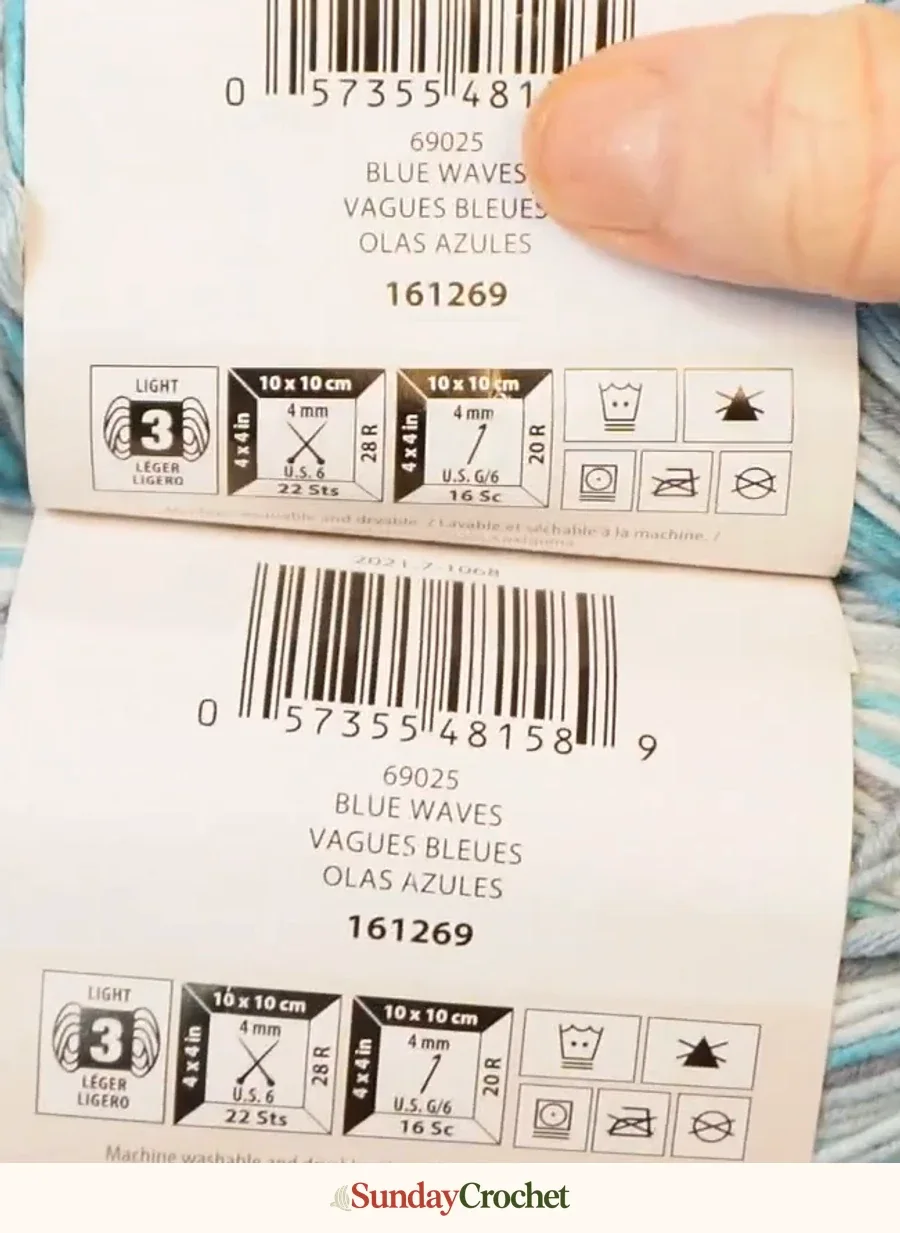
When you need several balls for one project, compare the color information and the dye lot across them. Batches can differ slightly in shade. A small difference may become noticeable when two sections sit beside each other in a sweater or blanket.
Both bands in the photo have the same shade information and the same lot number. That is the combination to look for when buying matching balls. Check each band, rather than assuming every ball in the same shelf space comes from one batch.
The ivory label uses another approach: it says no dye lot. Its color name and number are still present, but it does not provide a batch code. Read the actual wording on the band and avoid confusing its color number with a lot number.
Check the project instructions on the band, too
Some yarn bands also include a pattern or details about a pictured project. Look for the size information and required tools if that project is what you want to make.
A project printed on the band may call for a 4 mm hook, also identified as US G/6. That is a tool recommendation for the particular pattern. Keep it separate from the general crochet gauge box on the yarn label.
The project photo may catch your attention first, but the instructions connect the picture with the yarn and tools you need. Check those requirements while shopping so you understand what the band is asking you to make.
Common questions
Is yarn weight the same as grams per ball?
The category describes strand thickness. Grams describe the mass of yarn in the ball. Read the meters or yards as well to find the length you are buying.
Can I use the knitting gauge for crochet?
Use the crochet box when it is provided. The knitting counts describe another fabric, so they are not interchangeable with crochet counts even when both tools have the same millimeter size.
How do I know how many balls to buy?
Divide the pattern's required amount by the amount in one ball, keeping the units the same. Round up to a whole ball. In the example above, 600 meters divided by 175 meters requires four balls.
What should match across several balls?
Check the intended yarn, color name or shade code, and dye lot where a lot is given. Then confirm the quantity using the length or mass specified by your pattern.
Before choosing your yarn, work through the band once: thickness, quantity, fiber, crochet gauge, care, and color batch. You will have the information you need to compare it with your project, without trying to decode every number at once.