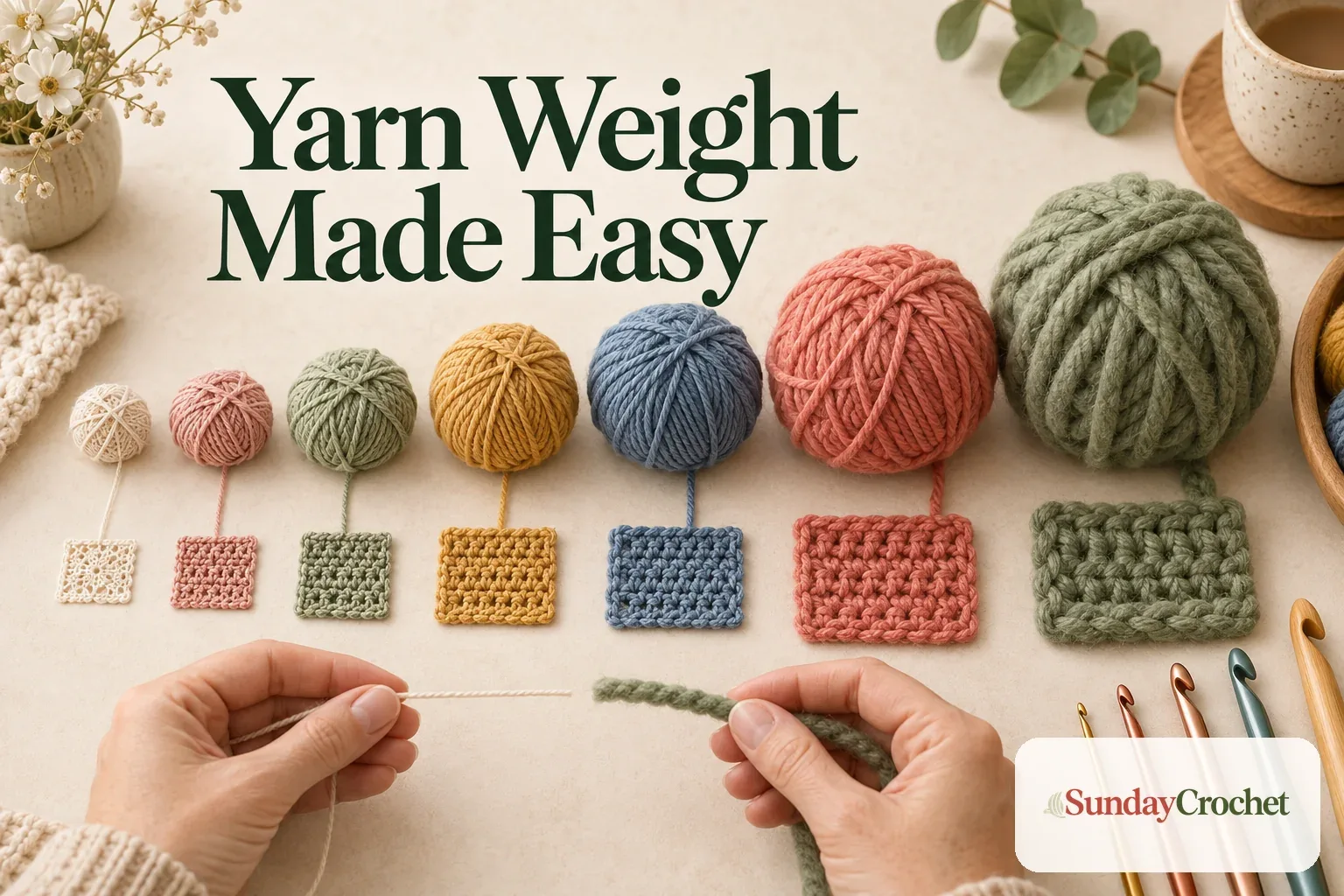
Yarn weights arranged from lace to jumbo. · Sunday Crochet
In this article
01 · What yarn weight actually means02 · The yarn weight categories, from 0 to 703 · How to identify yarn weight04 · Choose the yarn for the fabric you want05 · Hook size is a starting point, not a command06 · How to substitute yarn without a surprise07 · Common questions08 · Choose by evidence, then trust the swatchWhat yarn weight actually means
I’ll show you how I do this. When I pick up a skein, I separate three ideas that are easy to mix together: strand thickness, the physical weight of the skein, and fiber content. Yarn weight means the thickness category of the strand. A 50 g ball and a 200 g ball can both contain DK yarn. The larger ball simply contains more of it.
Thickness affects the scale of every stitch. Fine yarn makes smaller, lighter stitches and usually takes more stitches to cover the same area. Thick yarn makes large stitches, builds fabric quickly, and can hide delicate detail. Neither is better. The useful question is whether that thickness will make the fabric your project needs.
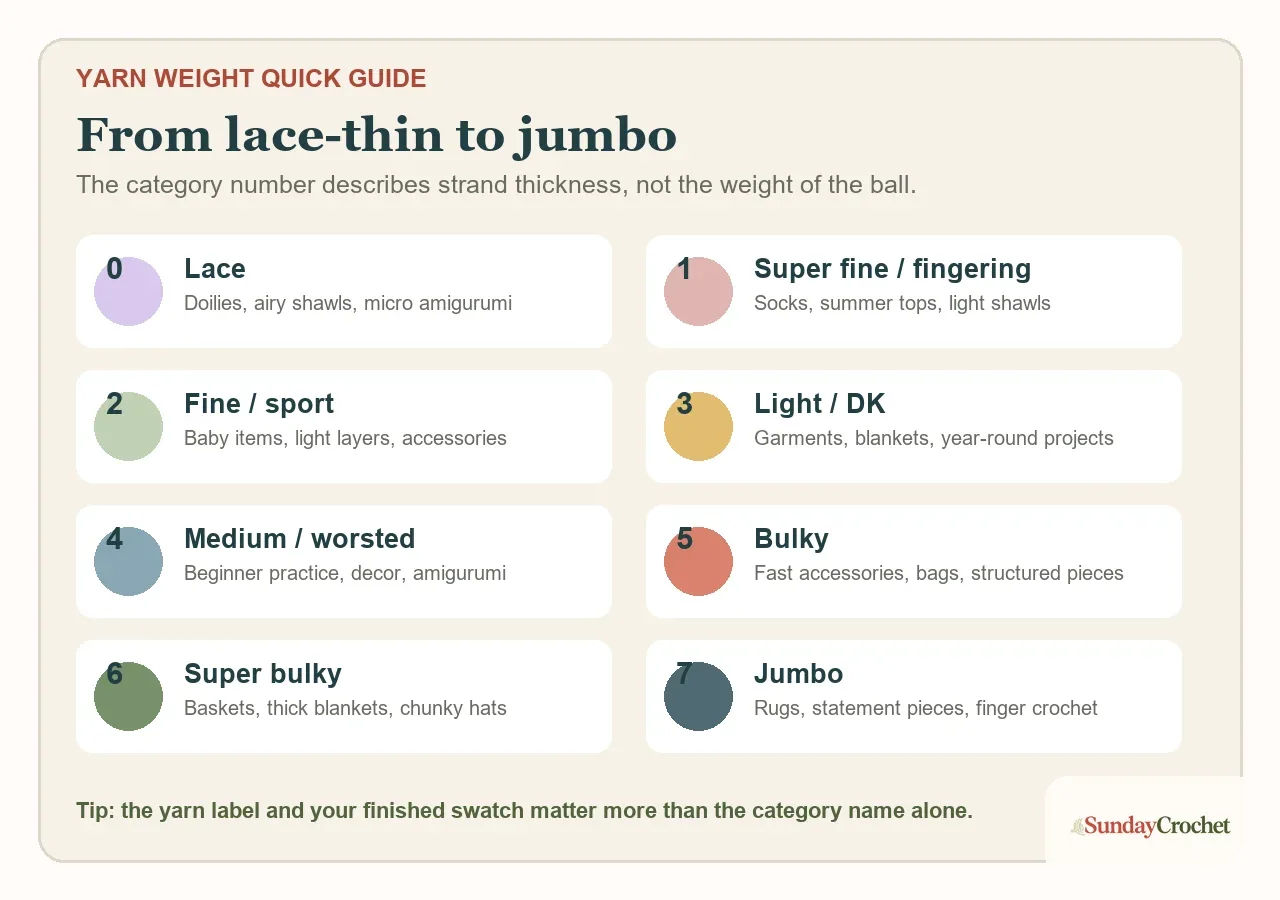
The standard system runs from 0 to 7. Category 0 is lace, the finest group, and category 7 is jumbo, the thickest. Names such as fingering, sport, DK, worsted, aran, bulky and chunky sit beside those numbers. The names help when you shop, but the number is often easier to compare across brands.
One label number is not a promise.
Two yarns marked category 3 can still feel different because the fiber, twist, loft and yards per 100 g are different. Use the number to narrow your choices, then compare the yarn more closely.
The yarn weight categories, from 0 to 7
Weights 0–2: lace, fingering and sport
Category 0, lace, includes very fine yarns and crochet thread. It suits doilies, airy shawls, heirloom-style pieces and tiny amigurumi. Lace yarn can also be held with another strand to add a soft halo without much bulk. On its own, it rewards patience; the stitches are small and mistakes can be harder to see.
Category 1, super fine, is commonly called fingering or sock weight. It has more body than lace while keeping beautiful drape. Think lightweight sweaters, summer tops, shawls, socks and blankets made from many small stitches. Fingering yarn and sock yarn may share the same weight, but sock yarn is often spun and blended for abrasion resistance. That construction matters if the finished piece will rub inside a shoe.
Category 2, fine, is better known as sport weight. It sits neatly between fingering and DK. I reach for it when I want a light garment or baby blanket that feels more substantial than fingering but not as warm or dense as worsted.
Weights 3–4: DK and worsted
Category 3, light, includes DK and light worsted. DK stands for “double knitting,” a name that came from holding two finer strands together. It has enough thickness to grow at a satisfying pace while still giving garments and blankets a comfortable drape. It works across seasons and is one of the easiest weights to use for colorwork.
Category 4, medium, includes worsted, afghan and aran yarns. This is the weight many beginners meet first because it is easy to find and the stitches are large enough to see. It suits practice swatches, blankets, home decor and amigurumi. If you are still learning the foundation chain and single crochet, a smooth, light-colored worsted yarn lets you see where the hook belongs. Aran is often a little heavier than a typical worsted yarn, even though both may wear the same category number.
Weights 5–7: bulky, super bulky and jumbo
Category 5, bulky, makes quick, structured fabric. It works well for hats, scarves, bags, oversized wearables and sturdy home pieces. The stitches are visible, which can feel beginner-friendly, but the thicker fabric becomes heavy if a project is very large.
Category 6, super bulky, is made for speed and presence. It is a natural fit for baskets, thick blankets, chunky cowls and plush pieces. Because each stitch uses a lot of yarn, check the required yardage before you buy. A project may be quick to crochet and still need several large skeins.
Category 7, jumbo, includes extremely thick yarn and roving. It creates bold stitches for rugs, statement scarves, bags and finger crochet. Fine detail is harder to achieve, so simple shapes and textures usually show it at its best.
What the category number cannot tell you
The number does not describe softness, warmth, stretch or durability. It also does not tell you how sharply the stitches will stand out. Those qualities come from the fiber and the way the yarn is made. A smooth cotton and a fuzzy wool can both be category 4, yet the cotton may feel cooler and show every stitch while the wool traps more air and softens the edges.
Ply count causes another bit of confusion. A ply is one strand used in the yarn’s construction, not a weight category. A four-ply yarn is not automatically thicker than a two-ply yarn because the individual plies can be spun at very different sizes. In some places, names such as “4 ply” are also used as familiar size labels. When you are unsure, go back to the actual yardage, fiber and a swatch instead of trying to decode the name alone.
Texture changes the picture too. Brushed, boucle and chainette yarns hold air, so they may look fuller than their mass suggests. A tightly spun yarn can be compact and dense. Hold the strand loosely between your fingers. Does it spring back, flatten easily, shed a halo, or feel almost cord-like? That little test hints at how the finished fabric will behave.
Color matters while you crochet, even though it does not change weight. Very dark shades hide the shadows that define stitch tops. Busy variegated yarn can disguise texture. If the pattern has cables or a detailed stitch repeat, a solid or gently heathered shade often makes the work easier to read.
How to identify yarn weight
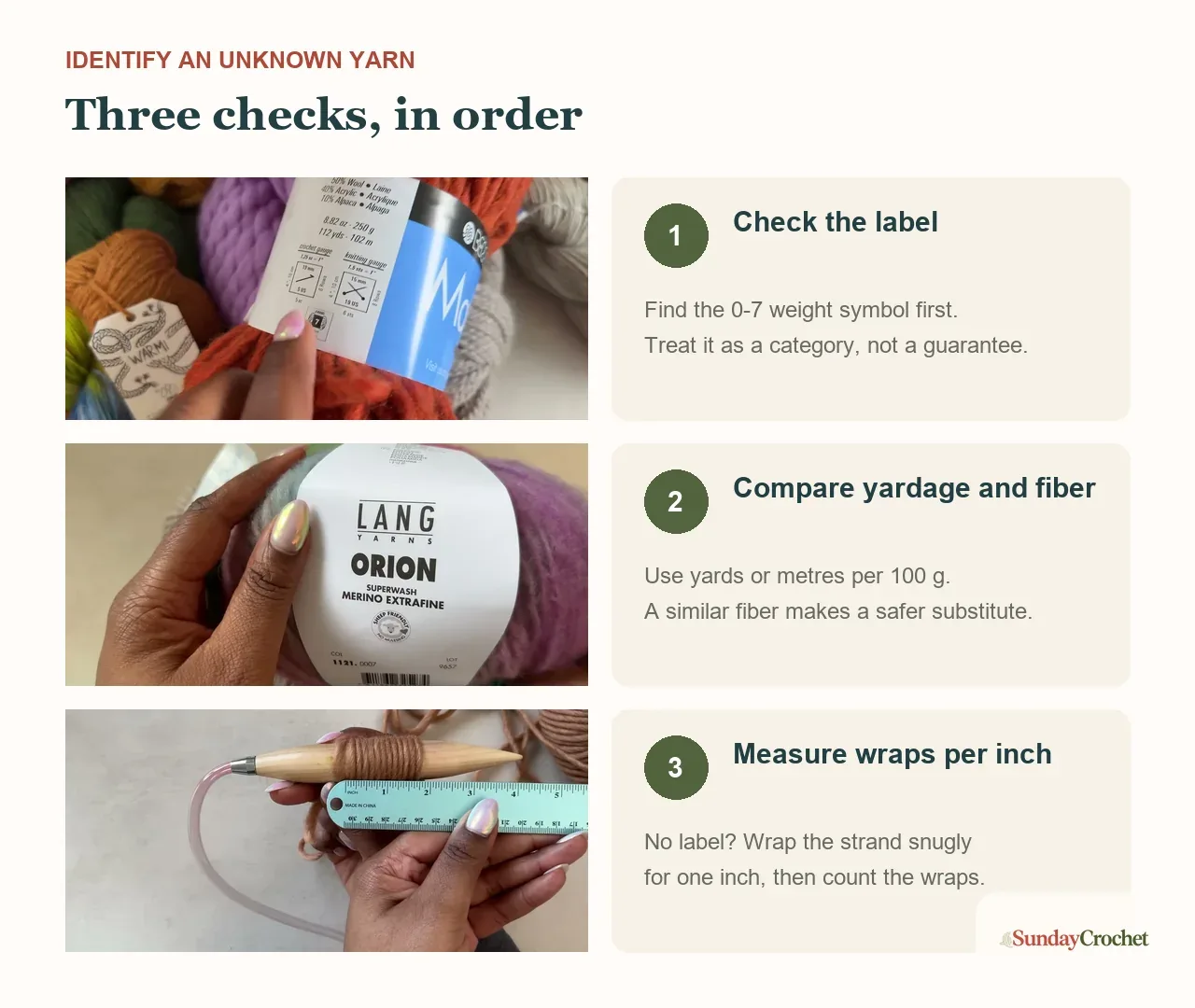
Start with the label. Look for a yarn-ball symbol containing a number from 0 to 7. Nearby you may find suggested hook or needle sizes and a sample gauge. If the label uses unfamiliar shorthand, treat it the same way you would when reading crochet abbreviations: isolate one symbol, find its meaning, then move to the next piece of information.
Next, compare length for a standard mass, ideally yards or metres per 100 g. More yardage usually means a finer strand; less yardage usually means a thicker one. Compare fiber too. A lofty wool yarn can look thick while remaining light, and a dense cotton can pack less length into the same 100 g. Yardage is a strong clue, not proof by itself.
If the label is missing, measure wraps per inch, often shortened to WPI. Wrap the yarn around a ruler or another smooth tool without stretching it and without leaving gaps. Measure a one-inch section and count the wraps. Compare that count with a WPI chart. Fine yarn makes more wraps; thick yarn makes fewer.
Choose the yarn for the fabric you want
Project type is the quickest filter. A basket needs enough firmness to hold its shape. A shawl needs movement. A fitted sweater needs a fabric that bends without sagging out of place. A toy usually needs tight stitches so the filling stays hidden. Imagine the finished fabric before you fall in love with a color.
Then consider season and fiber. Fine cotton or linen can make an airy warm-weather top. Wool traps warmth, so the same thickness can feel cozier. Acrylic offers broad color choices and straightforward care. A fuzzy halo softens stitch definition, while a smooth, tightly twisted yarn makes cables, colorwork and textured stitches easier to read.
Also think about the work itself. Dark yarn, novelty texture and very fine strands make individual stitches harder to see. That can be worth it for the final look, but I would not combine all three in a first project. A smooth yarn in a mid-range weight gives your eyes and hands more feedback.
Hook size is a starting point, not a command
A yarn label may suggest a crochet hook and show the gauge achieved in a sample stitch. Use that suggestion for your first swatch. Your hands, hook material and tension may produce a different result. The pattern gauge matters for size; the fabric in your hands matters for feel.
A smaller hook packs the stitches closer together. The fabric becomes firmer, with less drape and smaller gaps. That can suit amigurumi, rugs and baskets. A medium hook often gives balanced everyday fabric for hats, scarves and blankets. A larger hook opens the stitches and adds movement, which can suit shawls and relaxed garments.
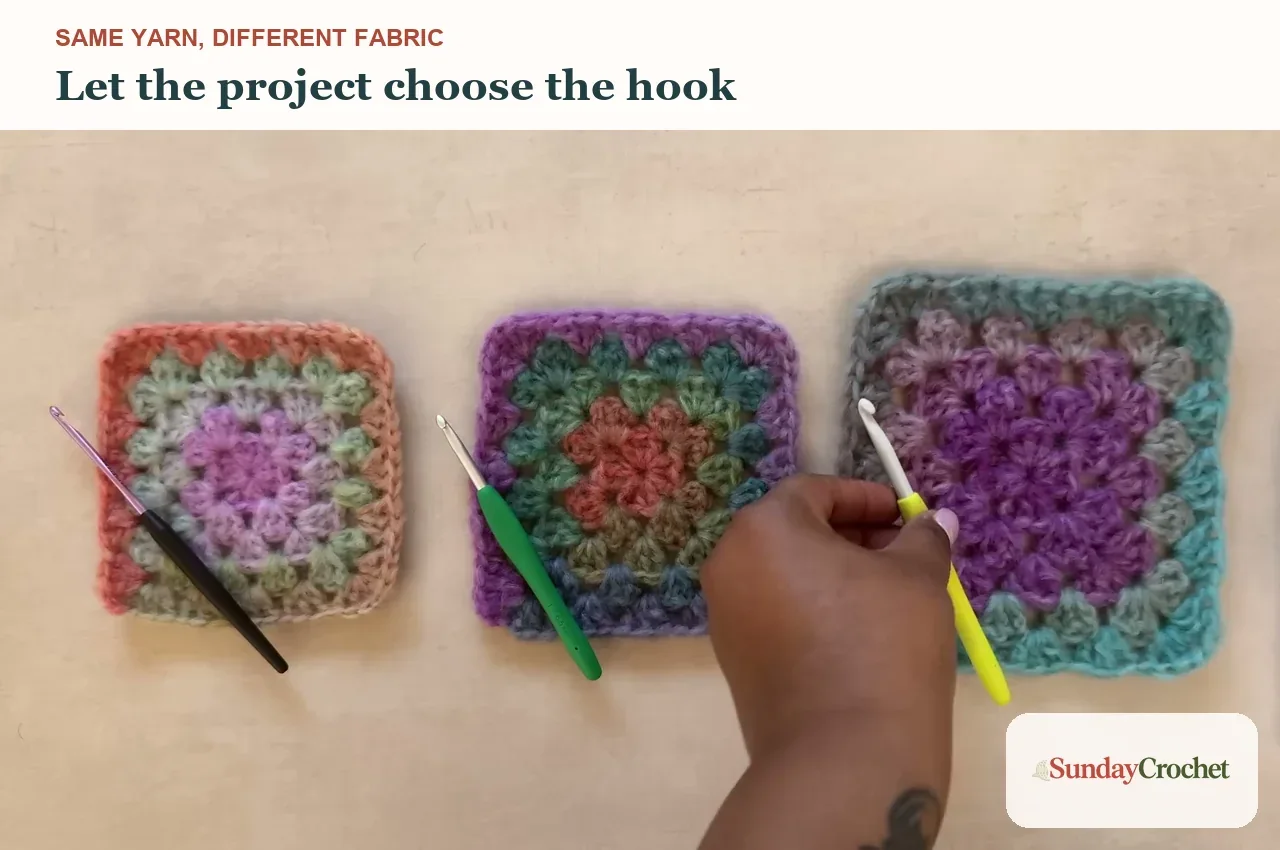
Make a swatch larger than the measurement area in the pattern, wash or block it as the finished item will be treated, then measure the center. If you have too many stitches in the required width, try a larger hook. If you have too few, try a smaller one. For a scarf or decorative piece without a strict finished size, choose the hook that gives you the fabric you like.
How to substitute yarn without a surprise
Matching the category number is only the first check. Compare the original and replacement yarns by yardage per 100 g, fiber content and construction. Try to stay close on all three. A dense cotton and a springy wool may match on the label yet behave very differently in a garment.
Buy enough total yardage, not simply the same number of skeins. If a pattern needs 1,000 yards and the original comes in 250-yard balls, it needs four. A substitute sold in 180-yard balls needs six to cover the same yardage, with a little margin. Skein counts are packaging; yardage is the usable amount.
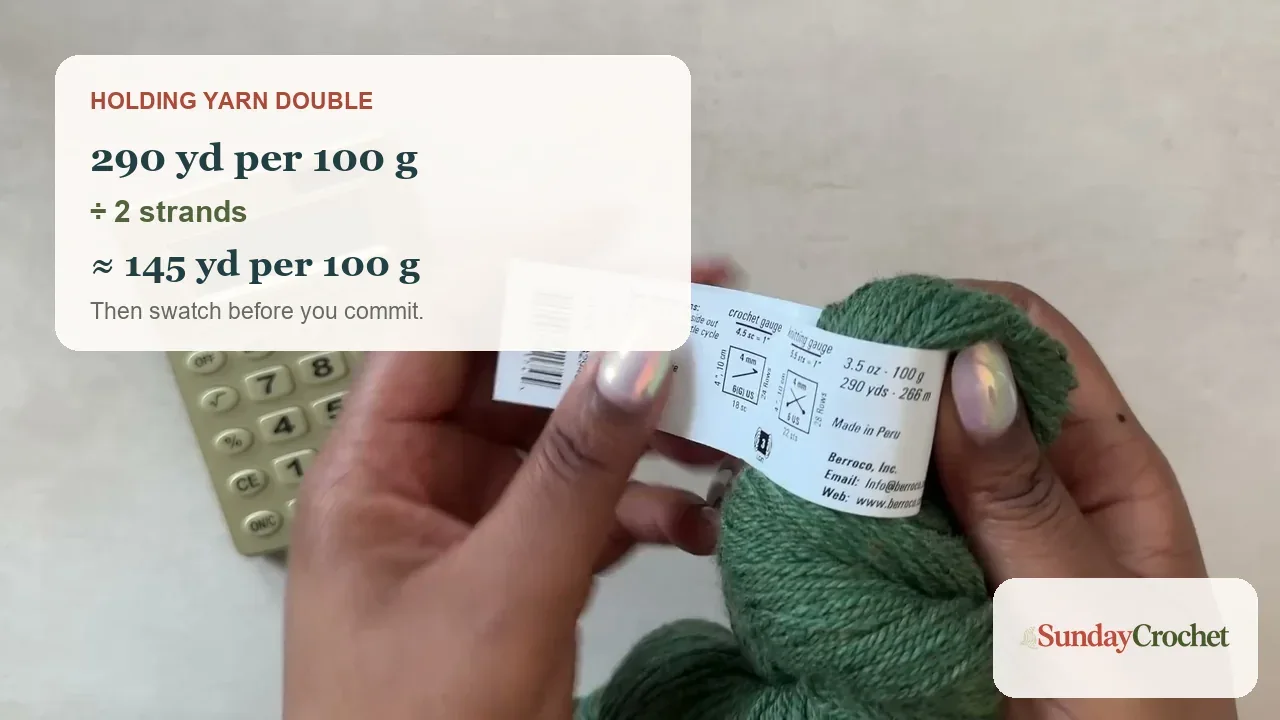
You can also hold two strands together. For two identical strands, halve the yardage per 100 g to estimate the combined thickness. A DK yarn with 290 yards per 100 g behaves roughly like 145 yards per 100 g when doubled, which moves it toward bulky territory. This is an estimate, so make a swatch before using it for anything that must fit.
My five-minute yarn check
- Match the project’s required weight category.
- Compare yardage per 100 g and fiber.
- Check whether the yarn will give the needed drape or structure.
- Choose a sensible starting hook.
- Make, finish and measure a swatch.
Common questions
Is DK yarn the same as worsted yarn?
No. DK is normally category 3, while worsted is category 4. Worsted is thicker, so swapping it into a DK pattern can make the fabric larger, denser and heavier unless you recalculate the project.
Are fingering weight and sock yarn interchangeable?
They can share category 1 and a similar gauge, but sock yarn is often constructed for durability and may contain nylon. A delicate fingering yarn can make a beautiful shawl and still be a poor choice for hard-wearing socks.
Can I use a different hook than the yarn label suggests?
Yes. The label recommendation is a starting point. Follow the pattern gauge when size matters, or adjust the hook until the fabric has the structure and drape you want.
What if my yarn has no label?
Measure wraps per inch, compare the strand with yarns you already know, and make a swatch. WPI narrows the category; the swatch tells you how that particular yarn behaves.
Does thicker yarn always make a warmer project?
Often, but fiber and stitch pattern matter too. Wool traps heat differently from plant fibers, and an open stitch pattern can feel airy even in a thick yarn.
Choose by evidence, then trust the swatch
The number on the label gets you into the right neighborhood. Yardage, fiber and construction bring you closer. The swatch makes the final decision. Once you start reading yarn this way, substitutions feel less like a gamble and more like a small, useful experiment.
Keep the first swatch even if it is wrong. Write the yarn and hook size on a tag, then make the next one. Side by side, those pieces teach you more about yarn weight than a shelf full of labels ever could.