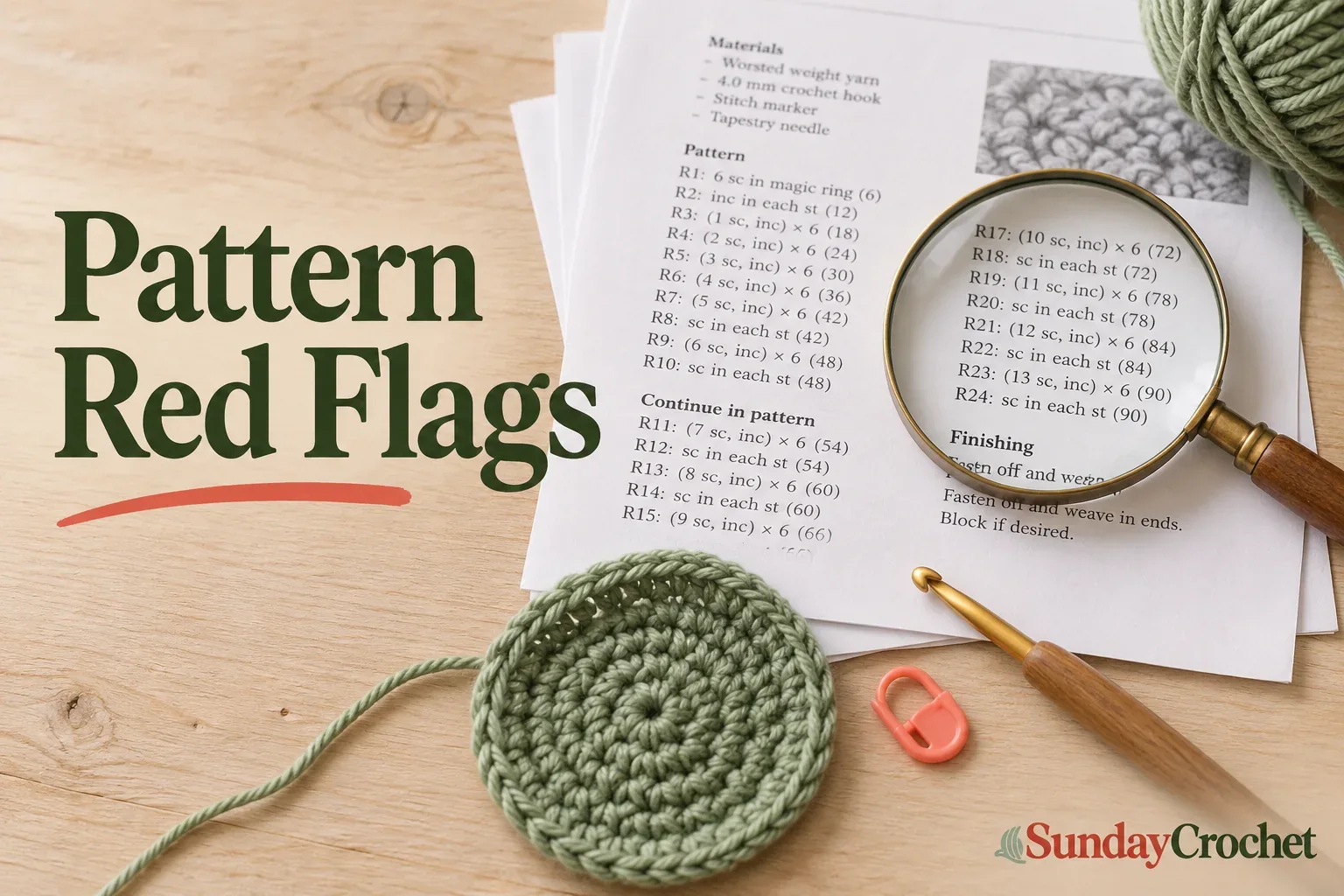
AI-generated editorial illustration; the printed pattern is fictional. · Sunday Crochet
In this article
01 · When the pattern might be the problem02 · Start with what you can actually verify03 · Check the construction and materials04 · Check whether the writing helps you make it05 · Look closely at the images06 · Decide where the evidence points07 · Common questionsWhen the pattern might be the problem
You picked a project because the finished photo looked wonderful. Now you’re several rounds in, and what’s on your hook seems to be heading somewhere else entirely. The head is round where it should have a shaped muzzle. The colors don’t line up. A stitch total refuses to work, even after you count it twice.
It’s easy to assume you’ve made a mistake, especially when you’re still learning. Sometimes that is the explanation. But a crochet pattern can also contain errors, leave out essential instructions, or promise a result its directions cannot produce. Crochet pattern scam red flags are worth checking before you spend another evening trying to fix something that was never explained properly.
I’ll show you how I would assess a suspicious pattern, from the written rounds to the finished photos. These checks also help before buying, wherever the listing gives you enough information to use them. A single warning sign isn’t proof of deception or AI involvement. What matters is whether the directions, materials, and pictures agree well enough for you to make the promised project.
Start with what you can actually verify
Keep the pattern and its finished image beside each other. Choose the section that is causing trouble, then look at its stitch count, shaping, color changes, and relevant photo. That is more useful than trying to decide whether the writing simply “sounds like AI.”
First, make sure you understand the abbreviation key, repeat boundaries, and stitch terminology. A missed bracket or a change between US and UK terms can make workable instructions look wrong. Being comfortable with how repeats and stitch totals are written gives you a fair starting point.
Then move through the checks below. Some point to a concrete contradiction; others are softer clues that tell you to look more closely. You don’t need to prove who wrote the file to decide that you need clearer instructions.
Check the construction and materials
1. The written shaping doesn’t explain the photo
Look at the part you’re making. Does the photo show a sloping face, an angled muzzle, or an unevenly shaped head? Now compare that with the rounds. If the instructions describe only a plain, evenly increased ball, find the step that creates those extra features.
The shaping might be explained later through separate pieces or finishing. Read ahead before deciding it is missing. But if the whole pattern offers no way to produce the visible structure, that mismatch deserves attention. The photo should show something the instructions actually build.
2. The stitch totals don’t add up
Pick a few rounds and calculate them independently. Check both how many existing stitches the repeat uses and how many new stitches it produces. Don’t assume the printed number is correct just because it appears neatly in brackets.
For example, “3 sc, increase” uses four stitches from the previous round and makes five. Repeating it six times uses 24 old stitches and produces 30 new ones. That is a counting illustration, not instructions for the project you’re checking.
One wrong total might be a typo. Repeated contradictions, particularly through shaping sections, are a much stronger reason to pause. No particular stitch number is suspicious by itself; it has to agree with the instructions.
3. The colors in the materials list don’t match
Compare the yarn colors listed with the finished image and the color-change instructions. If the sample has several distinct colors but the materials mention only two, look for an explanation.
Some details might be embroidered, painted, made with multicolored yarn, or offered as optional variations. Those possibilities need to be stated clearly enough to follow. If the photo shows colored details that appear nowhere in the materials or directions, you’re missing part of the promised result.
4. The yarn description leaves you guessing
Look for the yarn weight and fiber used for the sample. “Use yarn” doesn’t tell you much about the fabric, size, or appearance you’re trying to reproduce.
Not every small motif needs a rigid yarn specification. A design may intentionally work with several weights. The concern is a very specific photographed result with too little material information to understand how it was made. Check the weight and fiber details on your own yarn label against whatever the pattern does provide, rather than treating all yarn as interchangeable.
5. There’s no useful guidance about substitutions
If the pattern gives alternatives, do they explain what changes? A useful note might distinguish a smoother yarn from plush yarn or explain which option keeps a similar shape. It should help you understand the choice.
Substitution advice is a supporting clue, not a requirement every designer must meet. Its absence becomes more concerning when the original yarn is vague too. You’re then being asked to reproduce a detailed object without either a clear starting material or a sensible alternative. Different fiber properties can affect the fabric you make, so those gaps matter in practice.
6. The hook information is missing or unexplained
Check whether a hook size is supplied and whether it makes sense alongside the yarn and intended fabric. A recommendation that seems unusual needs context, especially for a closely worked toy.
An unexpected pairing can be deliberate. Don’t reject a pattern simply because the hook differs from a yarn label’s suggestion. Look for an explanation of the intended result. Missing yarn details, no hook information, and a highly specific finished photo together give you much less to work with than any one omission alone.
Check whether the writing helps you make it
7. Difficult sections have no troubleshooting notes
Find the place where the construction becomes less obvious: a join, a change of direction, or a shaped section. Does the pattern explain what to watch for there, or does it jump straight past it?
A short, simple pattern may not need extra notes. But a complex assembly with no clarification at its trickiest points can leave you stranded. Practical explanations about a likely mistake or an awkward placement help connect the directions to the object on your hook.
8. There are no specific details about making the sample
Look for information that belongs to this project: why a material was chosen, what needed adjustment, or where a particular section is easy to misread. Those details can be useful signs that the instructions reflect an actual making process.
A personal story or lots of “I” and “my” isn’t necessary. Some excellent patterns are deliberately concise, and a story can be invented. Treat project-specific observations as helpful context, while judging the technical instructions on their own merits.
9. Flowery descriptions replace technical information
A listing can describe a project as beautiful, delightful, or charming and still contain a good pattern. The problem comes when those adjectives do the work that measurements, stitch directions, and construction explanations should do.
Read a confusing paragraph with its promotional words mentally removed. Is there still a clear action and a clear place to work? If you’re left with enthusiasm but no usable instruction, more praise for the finished object won’t resolve the gap.
10. Craft terms are mixed without explanation
Watch for knitting instructions dropped into a crochet sequence, or a photographed knitted detail with no method for making it. The issue is whether you can follow the construction consistently.
Crochet projects can legitimately include sewing, embroidery, or knitted pieces. “Sew the arms on” is an ordinary assembly instruction. A stray word is also possible in an otherwise sound pattern. Look for unexplained changes of technique or repeated confusion, rather than treating any mention of sewing or knitting as a warning by itself.
11. The “beginner” label doesn’t match the work
Compare the skill label with what the project asks you to do. Are there complex shapes, many small components, or intricate finishing steps that are barely explained? “Easy” on the cover doesn’t remove those demands.
Skill labels are subjective, and human-written patterns can misjudge them too. What you need is a reasonable match between the claimed level and the support provided. If you’re new, a challenging pattern should still tell you clearly what skills it assumes, so difficulty doesn’t turn into needless self-doubt.
Look closely at the images
12. Essential-looking props are never explained
Inspect the little extras around the crochet. Tiny pots, tools, supports, or decorative pieces can make a finished scene attractive. Are they simply styling, or do they appear to be part of what the pattern promises?
Unusual props aren’t proof of a fake image. The useful question is whether you’re expected to reproduce them. If the result depends on accessories that aren’t identified anywhere, the listing may be showing more than its instructions can deliver. Clarify that distinction before planning the complete scene.
13. The stitches merge or lose their structure
Zoom in where the photo is clear enough. Can you follow recognizable stitches, or do sections blur into swollen, fused shapes that stop behaving like a continuous fabric?
Image quality limits this check. Fuzzy yarn, shallow focus, compression, and ordinary photography can hide loops. Inspect several clear areas rather than judging one blurry patch. If the image provides no reliable view of its fabric, use the written construction and other photos to assess the design.
14. Stitch size changes strangely to create shaping
Look at the areas that bulge or taper. Does the construction explain how that shape is made, or do individual stitches simply appear to grow, shrink, or stretch in a way the directions never account for?
Different stitch heights, tension, yarn changes, and finishing can produce real variation. The warning sign is a visible effect with no corresponding method anywhere in the pattern. Bring this check back to the first one: the image and instructions need to tell the same construction story.
15. More photos don’t give you more views
A listing may have several images while showing the object from exactly the same angle each time. Different backgrounds are attractive, but they don’t help you understand the back, underside, joins, or hidden parts.
Look for genuinely different views or useful progress images, especially when the project has complicated shaping. A single photo doesn’t make a simple pattern untrustworthy. For a detailed object you’re struggling to interpret, though, repeated front views may leave the very area you need to see unexplained.
Decide where the evidence points
Don’t turn these checks into a score where three warnings automatically equal a scam. Give more weight to contradictions you can demonstrate than to style or presentation. A plain writing voice is a weak clue; several rounds that cannot reach their stated totals are a concrete problem.
| What you find | What it tells you |
|---|---|
| One typo or an unfamiliar abbreviation | Check the key and surrounding instructions first |
| Missing material or assembly details | You need clarification to reproduce the result |
| Repeated count errors and unexplained shaping | The pattern may need substantial correction |
| Limited or unclear photos | The images cannot settle your questions alone |
If you can identify the exact mismatch, ask for clarification about that part. “This repeat makes 30 stitches, but the round says 36” is easier to address than a general accusation. You can also ask how a visible feature is made when no step seems to explain it.
If the necessary information still isn’t there, pause the project rather than repeatedly undoing your work or inventing missing directions. That decision doesn’t require you to establish how the file was created. Your time and yarn deserve instructions you can reasonably follow.
Common questions
Does one wrong stitch count mean a pattern is a scam?
No. A typo, editing mistake, or misunderstood repeat can explain one discrepancy. Recheck the instructions, then look for a wider pattern of contradictions. The arithmetic matters more than guessing the writer’s intent.
Can I identify an AI-written pattern from its wording?
Wording alone cannot establish that. Personal stories, polished descriptions, and a concise technical voice can all appear in different kinds of writing. Focus on whether the instructions build the pictured object and whether the details agree.
What if I’m a beginner and think I’m the problem?
Check the terminology and repeats first, but don’t assume every difficulty is yours. You can compare the printed count with the stitches a repeat produces even while learning. If the pattern lacks essential information, needing an explanation is reasonable.
Should every crochet pattern have lots of photos?
Not necessarily. A straightforward design can work with clear writing and a small number of images. More complicated shapes benefit from views that explain their construction. Useful evidence matters more than the number of pictures.