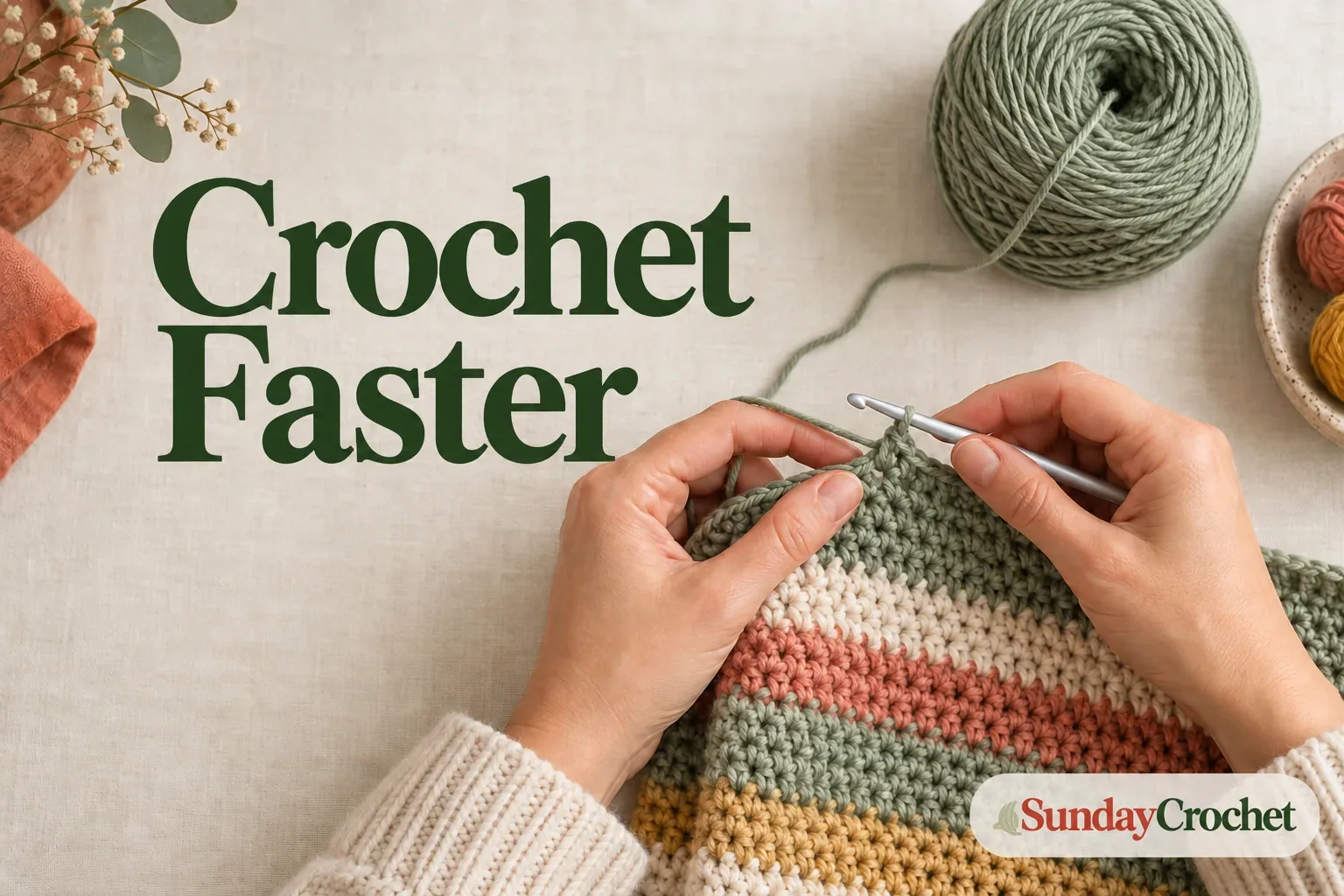
Small adjustments can make every stitch feel smoother. · Sunday Crochet
In this article
01 · What actually makes crochet faster?02 · Tips 1–2: make the yarn feed itself03 · Tips 3–5: reduce drag through your hands04 · Tips 6–7: let your body support the work05 · Tips 8–9: choose patterns that build momentum06 · Practice flow, not frantic movement07 · Common questions08 · The fastest stitch is the one you do not have to fightWhat actually makes crochet faster?
I’ll show you how I do this. I don’t try to force my hands to move at top speed. I look for every place where the yarn snags, the hook drags, the pattern makes me stop, or my posture creates tension. Fixing those small delays adds up quickly, and the stitching still feels like crochet rather than a timed test.
Your fastest setup will be personal. A knife grip is not automatically quicker than a pencil grip. A hook that glides through wool may feel slippery with cotton. Even the chair that feels comfortable for ten minutes may become tiring during a long session. Treat these tips as experiments, not rules.
Before you begin, choose a small swatch and one familiar stitch. Crochet for five relaxed minutes and notice what interrupts you. Does the skein roll away? Are you tugging for more yarn? Do you stop to reread the repeat? That baseline gives you something useful to improve.
The comfort rule
Speed should never create pain, numbness, tingling, or a sharp pulling feeling. Stop when something hurts. Repeated symptoms deserve advice from a qualified medical professional, not a tougher practice session.
Tips 1–2: make the yarn feed itself
1. Start with a center pull when it behaves well
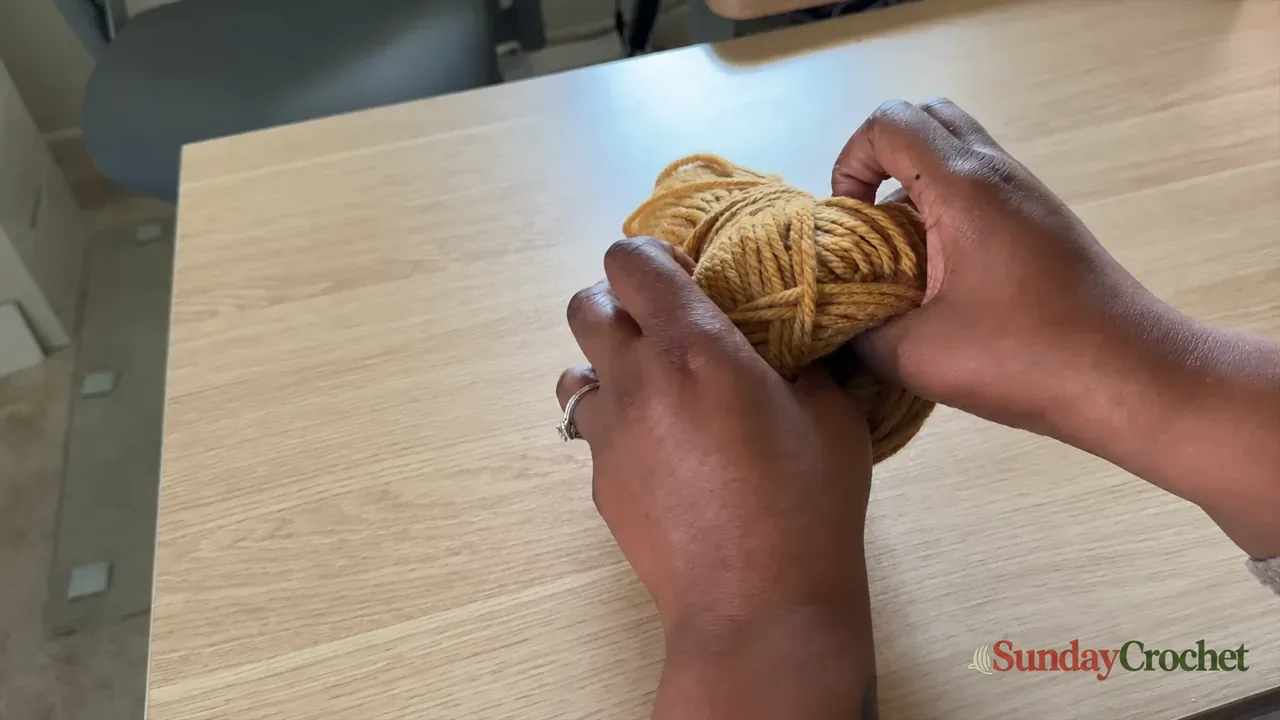
A skein that rolls, flips, or drags across the floor steals attention from every row. When the yarn allows it, working from the center keeps the skein mostly still. Tuck the outside end around the label or secure it loosely so you do not accidentally work from both ends.
To find the center, place a few fingers into each end of the skein and feel toward the middle. Pull out a small bundle rather than digging for one perfect strand. The loose clump that comes with it is normal; unwind it gently before you begin. If the center collapses into knots, stop fighting it. Wind the yarn into a cake and use the clean center strand from there.
2. Keep the skein in one controlled place
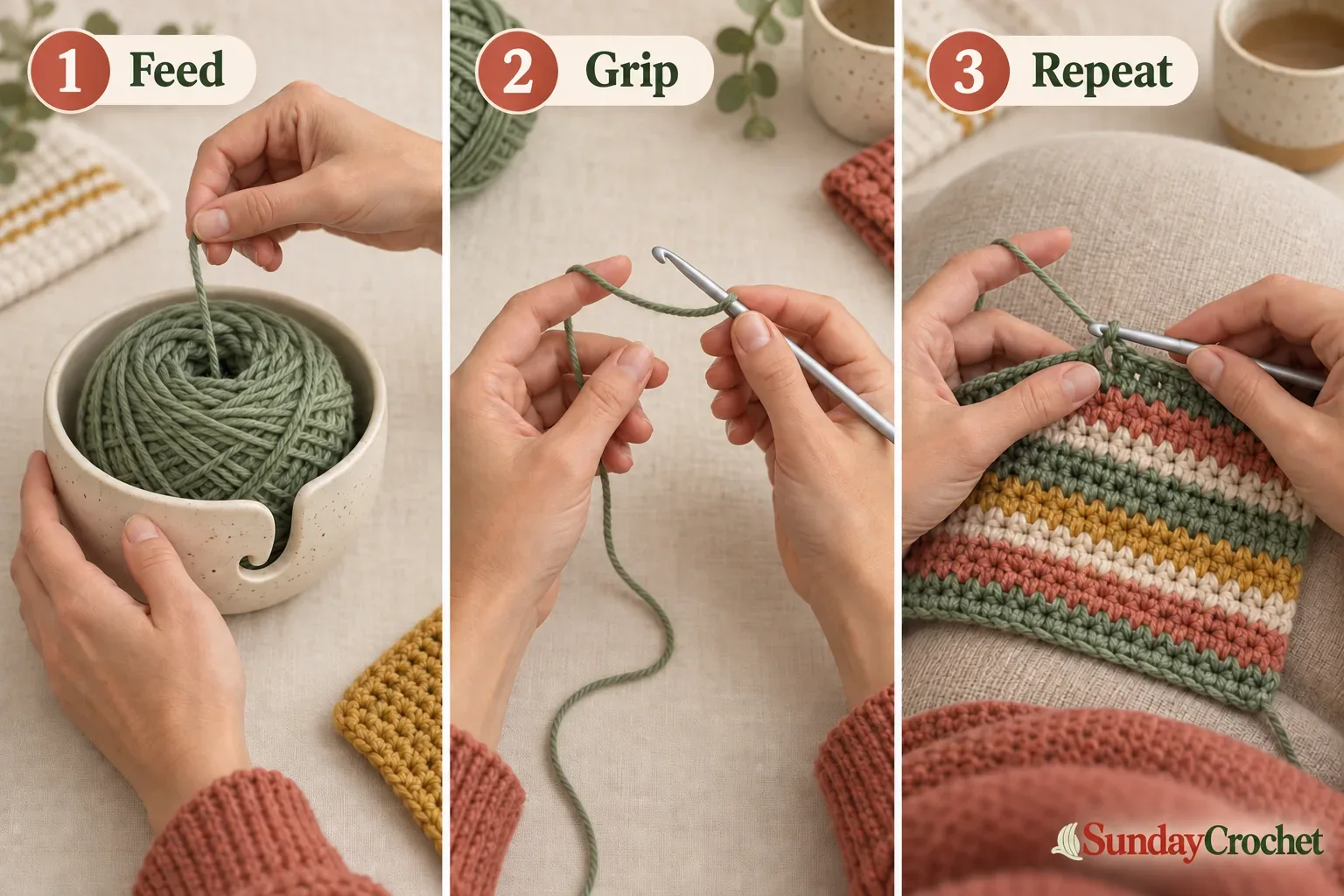
A project bag, yarn bowl, or smooth container prevents wandering yarn and keeps the strand away from chair legs. The best choice is the one that matches the way you pull. If you give the working yarn an occasional firm tug, a light yarn spindle may tip or jump. A stable bowl or bag may serve you better.
Place the yarn on the same side as your tensioning hand and leave a clear path between the skein and your fingers. Pull out a comfortable length before you start a long repeat. You want enough slack that the yarn moves freely, but not so much that loops collect around your feet.
Tips 3–5: reduce drag through your hands
3. Try a hook with a smoother shaft
Hook material changes how much friction you feel. Wood has warmth and grip, which can be helpful with slippery fibers, but it may slow a strand that already has texture. Plastic is often smoother. A polished or brushed aluminum hook usually gives the quickest glide across a wide range of ordinary yarns.
The fastest hook is still one you can control. If the loops keep sliding off, you spend the saved seconds rebuilding stitches. Compare two hooks of the same size with the same yarn and make twenty stitches with each. Notice which one requires less pushing, pulling, and readjusting.
4. Adjust your grip instead of copying someone else
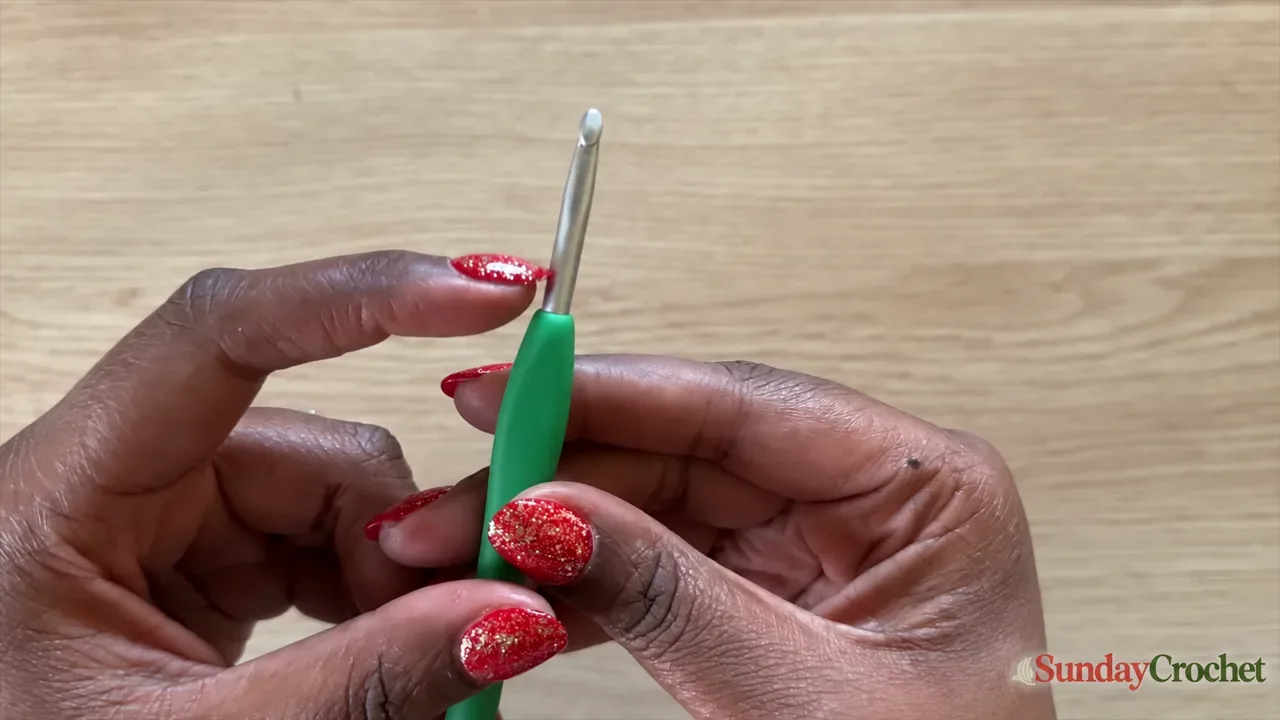
Knife hold and pencil hold can both be efficient. What matters is whether the hook can rotate, enter the stitch, catch the yarn, and return without a large detour. Slide your hand slightly up or down the handle. Try supporting it with a different finger. A change of only a centimeter can reduce wrist movement.
Keep the grip secure but light. White knuckles are a sign that your hand is working harder than the stitch requires. A wider ergonomic handle may help if you squeeze a narrow hook, although handle shape is personal. Test a grip long enough to feel the rhythm, then return to your usual position and compare.
5. Use only enough yarn tension for control
Tension has to balance two jobs: it keeps the working strand predictable, and it lets that strand slide. If you wrap the yarn tightly around several fingers, every yarn over becomes a small tug-of-war. If you hold it too loosely, the loops change size and the hook has to chase them.
Fine yarn may need an extra point of contact around a finger. Thick yarn often moves better with a looser path. Fiber matters too. Cotton can feel firm and direct, while wool may compress and spring back. This is where understanding yarn weight and fiber helps: adjust the hold for the strand in your hand instead of forcing every yarn through one tension method.
Tips 6–7: let your body support the work
6. Sit tall enough to breathe and move
When you are concentrating, it is easy to lift your shoulders, fold toward the project, and bring the hook close to your face. That position may feel precise for a few stitches, but it creates fatigue through the neck, shoulders, wrists, and hands. Fatigue makes movements smaller, tighter, and eventually slower.
Begin with both feet supported and your spine comfortably long. Let your shoulders drop and keep the elbows near your sides. Bring strong light to the project instead of bringing the project to your eyes. You do not need to sit like a statue; change position regularly and stand up between rows.
7. Keep the work low and supported
Hands held high in the air ask the shoulders to carry the entire project. Lower the work toward your lap and let a cushion support your forearms or the growing fabric. For a heavy blanket, place most of the weight beside you rather than letting it hang from the hook.
A nursing-style or crochet support pillow can create a soft platform across the lap. A folded bed pillow works for testing the idea before buying anything. The goal is not to lock your arms in place. It is to remove unnecessary lifting so the hands can focus on small, repeatable motions.
Reset every twenty to thirty minutes
Put the hook down, open and close your hands, roll the shoulders gently, and look across the room. A short reset protects comfort and often makes the next row quicker.
Tips 8–9: choose patterns that build momentum
8. Use a repeating stitch pattern
A repeat becomes faster once you no longer translate every instruction. Granny stripe, linen stitch, chevrons, and other predictable sequences let the eyes scan ahead while the hands continue. Mark the beginning and end of a repeat, then count at planned checkpoints instead of stopping after every group.
Do not sacrifice accuracy for flow. A missed stitch repeated across ten rows costs more time than a quick count at the end of one row. Keep the written repeat nearby until it is genuinely familiar, especially when shaping or color changes interrupt the sequence.
9. Choose simple stitches when the deadline matters
Single crochet and double crochet use fewer motions than bobbles, cables, and elaborate post-stitch textures. That does not make simple fabric boring. Color changes, stripes, yarn texture, and thoughtful proportions can create a striking project while the stitch rhythm stays easy.
If the basic movements are not automatic yet, practicing a foundation chain and single crochet builds speed more reliably than rushing through a complicated pattern. Consistency comes first. Speed tends to appear after the hands stop needing instructions for each loop.
Project scale matters as well. Bulky yarn and a large hook make bigger stitches, so the fabric grows quickly, but they can tire the hands if the tools feel heavy. A small cowl, simple scarf, chunky basket, or baby blanket with a memorized repeat can feel fast without becoming awkward.
Practice flow, not frantic movement
Set up a smooth yarn, comfortable hook, and simple swatch. Crochet normally for two minutes. For the next two, watch only the yarn feed. Remove snags and reduce unnecessary pulling. Then spend two minutes noticing the hook path: can it enter, catch, and exit with a smaller motion?
Use the next two minutes to relax your grip and shoulders. Finish with two minutes of ordinary stitching while keeping the changes that felt natural. Do not count stitches per minute during the first sessions. Count interruptions instead. Fewer stops, fewer dropped loops, and steadier gauge are better signs of lasting efficiency.
When the rhythm keeps breaking
If the hook repeatedly splits the yarn, first slow down and check the direction of its twist. Some loosely spun yarns separate more easily when the hook enters at a steep angle. Turn the hook slightly downward as it passes through the stitch, and make sure the entire strand sits in the hook throat before you pull through.
If the loops become tighter as you work, pause and look at the hand holding the yarn. You may be curling the fingers inward or adding another wrap without noticing. Shake the hand loose, reset the strand, and make five deliberately soft stitches. The goal is to recover an even movement before speed returns.
Frequent counting can also interrupt a good rhythm. Place a stitch marker after each full repeat or at regular intervals, such as every twenty stitches. Then you only need to verify the short section after the last marker. This catches mistakes early without making you recount an entire row.
Create a setup you can repeat
Before a longer session, put the hook, stitch markers, scissors, pattern, and water within easy reach. Sit in the same comfortable position you used for the practice swatch, then place the yarn where it can feed without crossing your body. A consistent setup saves the little searches and adjustments that quietly break your concentration.
Prepare the next color before you reach the change, and untangle enough yarn to finish the current repeat. If you use a digital pattern, keep the screen awake and enlarge the line you are following. For a printed pattern, use a removable note or ruler to mark your place. These habits do not make the hook move faster, but they protect the rhythm you have already built.
When you pause, stop at the end of a repeat and leave a marker in the active loop. Write down the row number if the project will sit overnight. Returning to a clear starting point is much quicker than studying the fabric and trying to remember where you stopped.
Once the setup feels automatic, time one five-minute sample every few weeks. Use the same yarn, hook, and stitch so the comparison is fair. If your stitch count rises while the fabric stays even and your hands feel good, the practice is working.
Common questions
How long does it take to become a fast crocheter?
There is no fixed timeline. Familiar stitches may feel noticeably smoother after several short practice sessions, while consistent speed develops through many projects. Measure progress against your own earlier work, not another crocheter’s hands.
Is knife grip faster than pencil grip?
Neither grip wins for everyone. The faster grip is the one that gives you controlled loops, a short hook path, and a relaxed wrist. Small adjustments within your preferred grip usually matter more than changing styles completely.
Which crochet hook material is fastest?
Metal hooks often create the least drag, particularly with textured or grippy yarn. Plastic may also glide well, while wood provides more control for slippery fibers. Test the hook with the actual yarn because the combination matters.
Does loose tension make crochet faster?
Only when it remains controlled. Extremely loose loops can fall from the hook or produce uneven fabric. Aim for tension that lets the yarn travel without resistance while keeping each loop a predictable size.
Can I crochet quickly without hurting my hands?
Yes, but comfort has to lead. Support the project, keep the grip light, take breaks, and stop for pain, numbness, or tingling. Speed built on strain is not sustainable.
The fastest stitch is the one you do not have to fight
Control the yarn, choose a hook that glides, relax your grip, and let the pattern become familiar. Those changes may seem small, but together they remove the stops that make a project feel slow.
Keep the experiments that make your hands feel calm and your stitches look even. Leave the rest. A comfortable rhythm will carry you through far more rows than one hurried burst ever could.