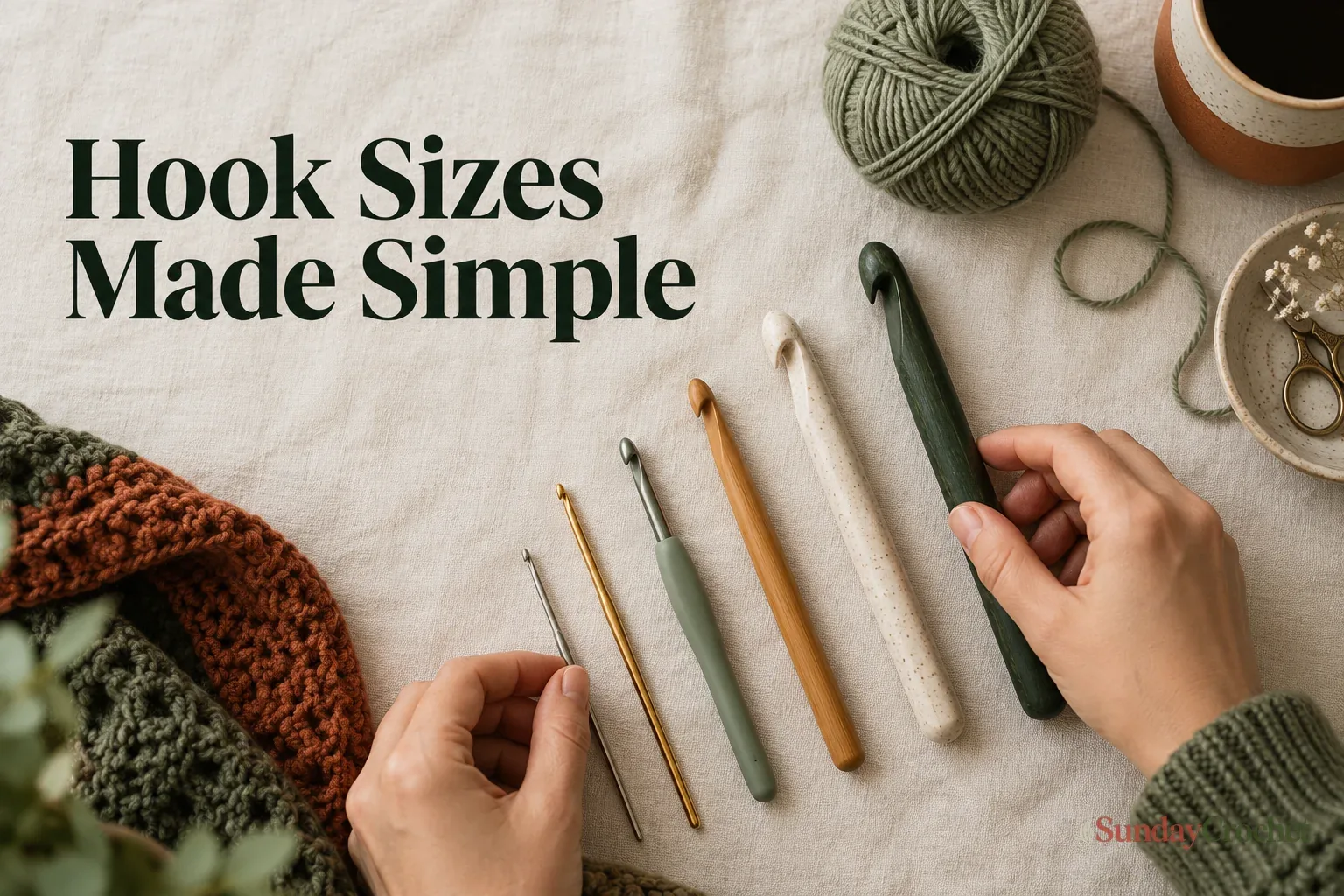
Millimeters give the clearest comparison when hook labels use different systems. · Sunday Crochet
In this article
01 · What does a crochet hook size actually measure?02 · Why one hook can have three different labels03 · Common crochet hook sizes in millimeters and US labels04 · Useful starting points for different crochet projects05 · How to choose the right crochet hook size06 · What happens when you change hook size?07 · Why two hooks marked 5 mm can feel different08 · How to check a hook with a missing size09 · Common questions about crochet hook sizes10 · Let millimeters lead the wayWhat does a crochet hook size actually measure?
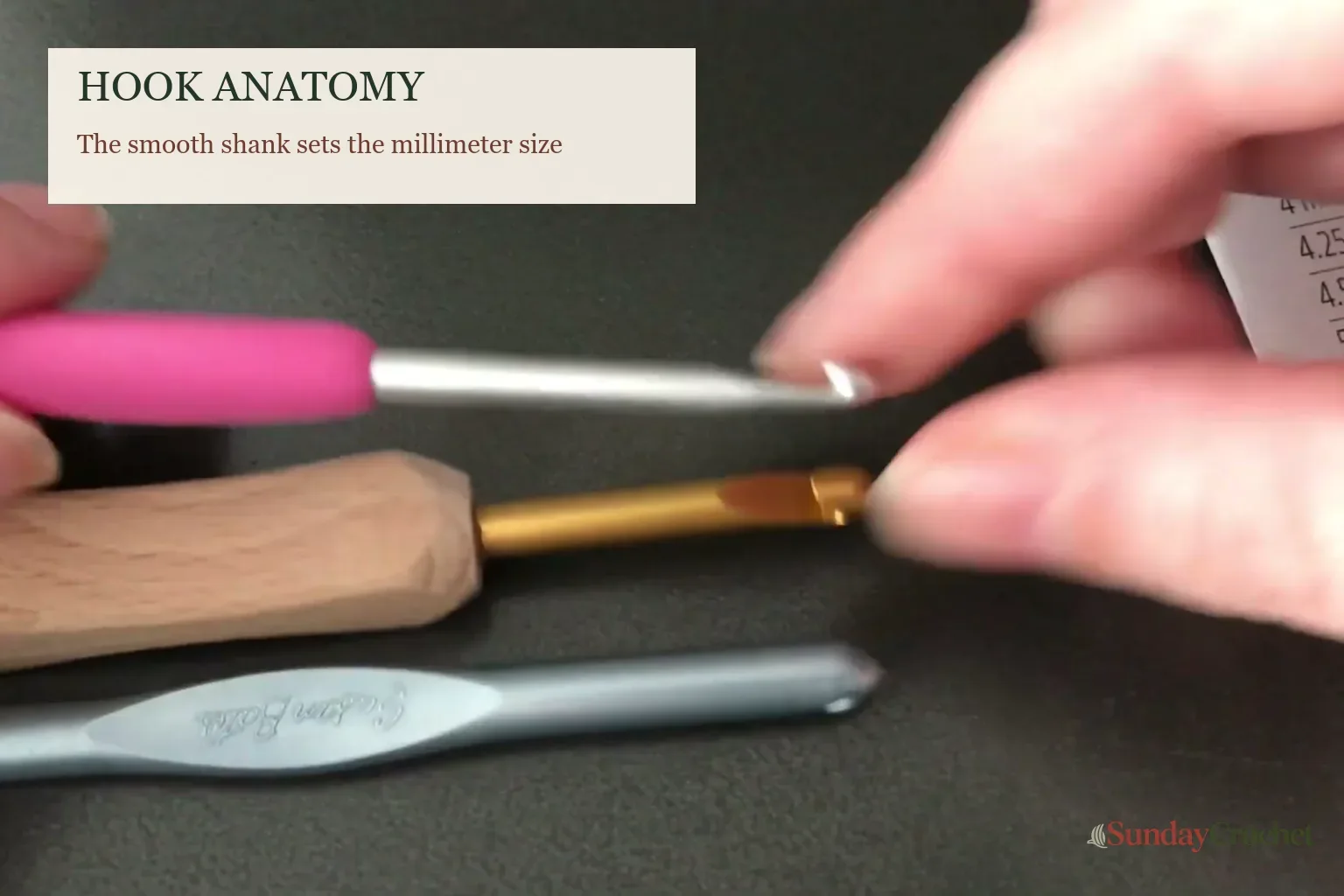
If a hook says H-8, 5 mm, or both, the size refers to the diameter of its shank. The shank is the smooth, straight part between the shaped throat and the handle or thumb rest. It is not the width of the hook head, the depth of the groove, or the thickness of an ergonomic handle.
I’ll show you how I do this. First, I ignore the color and handle shape and look for the millimeter marking. If it is missing, I check the shank with a hook gauge. That one habit removes most of the confusion before I even pick up the yarn.
A larger diameter forms larger loops. A smaller diameter forms smaller loops. That sounds obvious, but it explains why changing only the hook can turn the same yarn and stitch pattern into a dense basket fabric, a balanced sweater fabric, or an open, drapey scarf.
One important exception
Tiny steel hooks used for crochet thread follow a separate numbered system in which a higher number often means a smaller hook. Keep steel thread hooks separate from regular hooks so the two systems do not get mixed up.
Why one hook can have three different labels
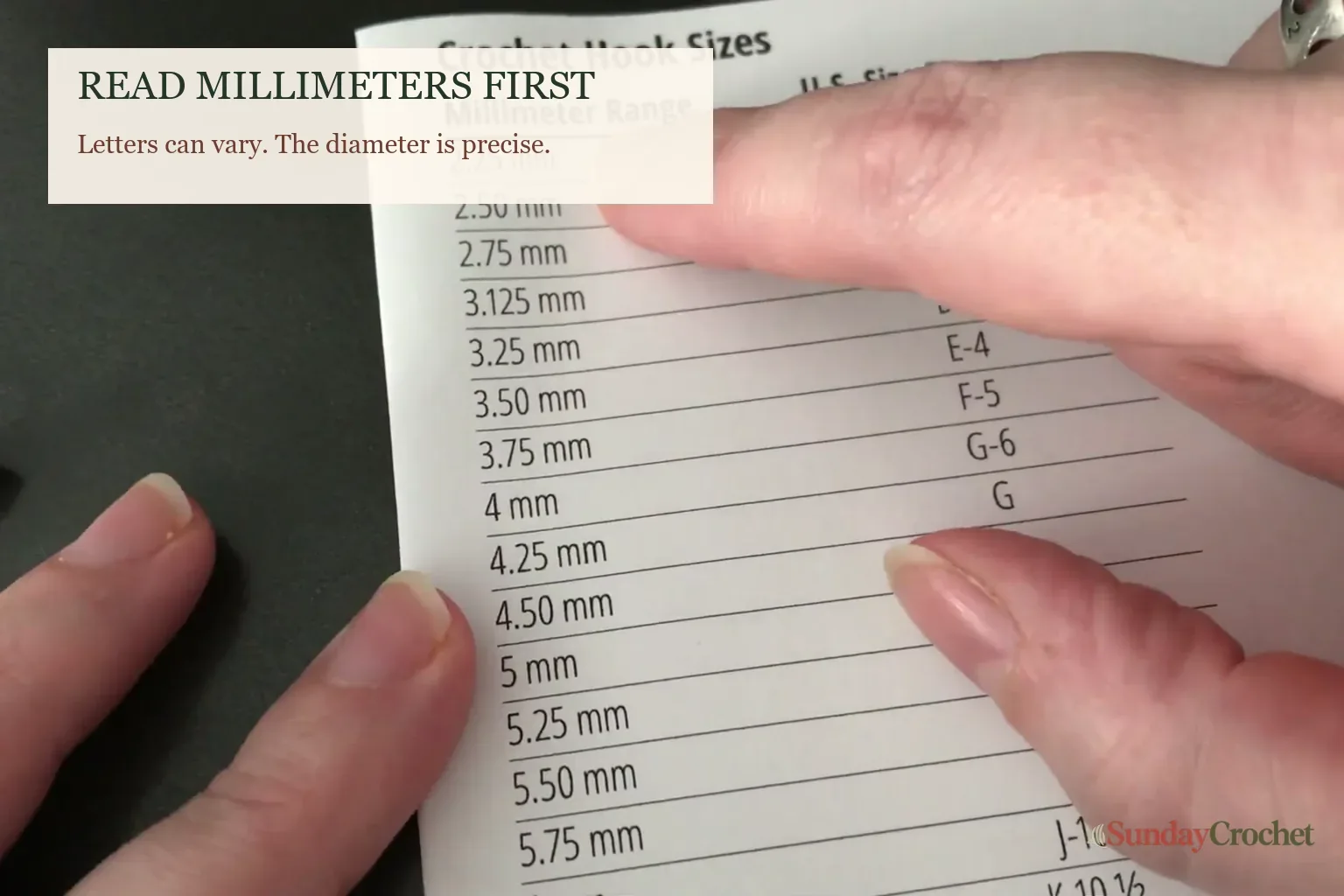
Hook sizing grew differently in different places, so the same tool may be labeled with a metric measurement, a US letter and number, or another regional size. A 5 mm hook, for example, is commonly labeled H-8 in the United States. The metric measurement is still 5 mm wherever you use it.
The millimeter size describes the physical diameter, which makes it the most dependable part of the label. US letters and numbers are convenient shorthand, but they are not perfectly standardized across every manufacturer. You may find a 4 mm hook labeled G-6 by one brand and simply G by another. A 4.5 mm hook might be labeled 7, and occasionally a brand places it close to G or H in its own range.
That is why I treat the letter as a quick name and the millimeter marking as the answer. When a pattern lists both, match the millimeters first. When it lists only a letter, check the designer’s conversion chart or pattern notes before assuming.
Common crochet hook sizes in millimeters and US labels
This compact crochet hook size chart covers several hooks you are likely to meet in everyday patterns. Think of the US label as a common match, not an absolute rule, and always check the actual hook marking.
| Millimeter size | Common US label | Often used around |
|---|---|---|
| 2.25 mm | B-1 | Fine yarn and detailed work |
| 3.25 mm | D-3 | Light yarn and firm stitches |
| 3.5 mm | E-4 | Lightweight projects |
| 3.75 mm | F-5 | Light to medium yarn |
| 4 mm | G-6 | DK and some worsted projects |
| 4.5 mm | 7 | DK or medium yarn |
| 5 mm | H-8 | Many worsted-weight projects |
| 5.5 mm | I-9 | Worsted yarn with more ease |
| 6 mm | J-10 | Worsted or bulky yarn |
| 6.5 mm | K-10½ | Bulky yarn and open fabric |
The “often used around” column is only a starting point. Yarn construction matters. A fluffy worsted yarn can behave differently from a smooth, tightly spun yarn of the same weight, and a designer may deliberately choose a smaller or larger hook to create a particular fabric.
Useful starting points for different crochet projects
The pattern or yarn label should come first, but it helps to know what you are trying to make the hook do. For amigurumi, a hook at the smaller end of the yarn’s suggested range usually creates a close fabric that keeps stuffing from peeking through. The hook still needs to enter each stitch comfortably. If you are forcing it, splitting yarn, or feeling strain in your fingertips, move up slightly and check whether the fabric remains firm enough.
For blankets and everyday accessories, begin near the middle of the suggested range. Crochet a sample large enough to bend and fold. A blanket fabric should feel pleasant across your lap, not like a board, while a bag may need more structure. The same worsted yarn could work with a 4 mm hook for a sturdy tote and a 5.5 mm hook for a softer throw. The project’s job matters as much as the yarn category.
For garments, drape and gauge must work together. A loose, beautiful swatch is not useful if it makes a sweater several inches too wide. Check stitch gauge and row gauge after washing the swatch, then decide whether the fabric still hangs the way you want. Sometimes changing the hook fixes both measurements. Sometimes you need a different yarn construction because the correct gauge feels too stiff.
For lace and openwork, designers often use a hook that looks surprisingly large beside the yarn. The extra room helps chains and tall stitches open after blocking. Resist the urge to tighten everything while you work. Make the sample, block it fully, and judge the spaces only after the yarn has settled.
These are starting points, not fixed pairings. Fiber, twist, stitch pattern, and your tension can move the answer in either direction. What matters is being able to explain the choice: smaller for structure, larger for openness, and always confirmed by the finished swatch.
How to choose the right crochet hook size
Start with the pattern when you have one. The listed hook is the designer’s route to the intended fabric, but it is still a starting hook, not a promise that every crocheter will get identical results. Your hand tension, hook style, and yarn can all change the size of your stitches.
If you are working without a pattern, check the yarn label. It usually suggests a hook range rather than one perfect size. The label becomes much more helpful once you understand yarn weight, because a yarn’s thickness narrows the sensible range of hooks before you make a swatch.
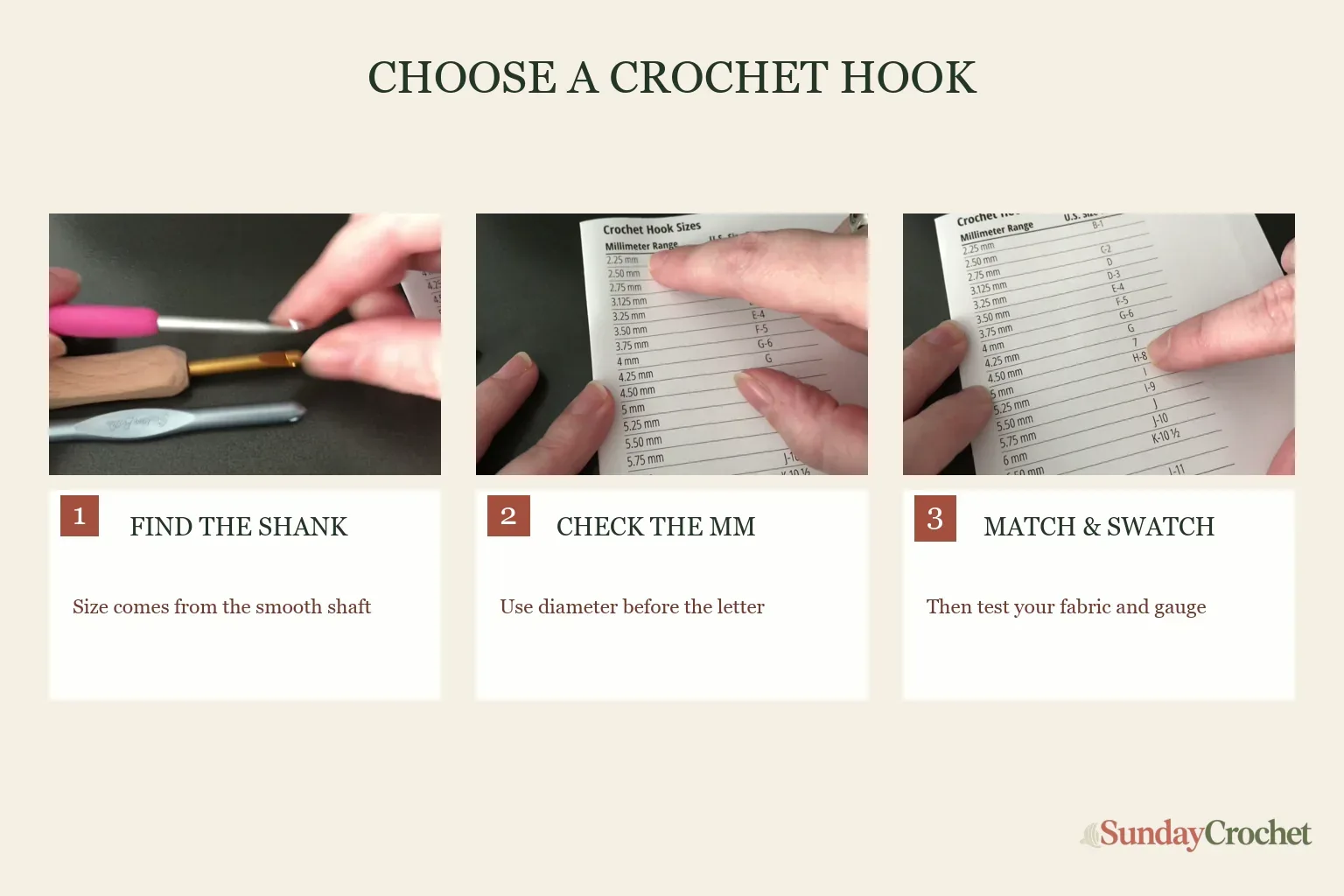
- Find the millimeters. Read the hook or pattern size in mm. If you only have a US letter, confirm its metric equivalent for that brand.
- Match the project. Use a smaller hook for firmness and structure, or a larger one for softness and drape, while staying realistic for the yarn.
- Make a swatch. Crochet enough rows and stitches to see the fabric clearly. Wash and dry it as the finished item will be treated.
- Measure, then adjust. If you have too many stitches per measurement, your stitches are too small, so try a larger hook. If you have too few, try a smaller hook.
When a written pattern names both a hook and a gauge, the gauge has the final word. It tells you whether your personal combination of hook, yarn, and tension matches the design.
What happens when you change hook size?
Go down a hook size and each loop becomes smaller. The stitches sit closer together, the fabric feels firmer, and the finished piece may measure smaller. This can be useful for amigurumi, baskets, bags, or any project where you want fewer gaps. Go too small, though, and the hook may struggle to enter the stitches. Your hands may also work harder than they need to.
Go up a hook size and the loops grow. The fabric usually becomes more open, flexible, and drapey. This can suit shawls, scarves, and airy garments. Go too large and the stitches may look loose, snag easily, or leave more space than the project needs.
There is no moral victory in using the hook printed on the yarn label. The right hook is the one that gives you the fabric and measurements the project requires. Two crocheters can use the same yarn and need different hook sizes to reach the same gauge.
Why two hooks marked 5 mm can feel different
Millimeters tell you the shank diameter, but they do not describe every part of the tool. One 5 mm hook may have a deep, sharply cut throat, while another has a rounded head and a shallow groove. Inline and tapered shapes catch and release yarn differently. Wood adds gentle drag, polished metal glides quickly, and coated or plastic hooks fall somewhere between depending on the finish.
Those differences can slightly change your tension even when the diameter matches. Your grip can change too. A thick ergonomic handle may help you relax, while a narrow handle may encourage you to squeeze. None of that makes one material or shape universally better; it only means your hands have preferences.
Once you begin a gauge-sensitive project, use the same hook for the whole piece. Switching to another 5 mm hook halfway through can create a subtle change in stitch height, width, or rhythm. If you must replace it, swatch with the new hook before continuing.
How to check a hook with a missing size
Printed sizes rub off, stickers peel away, and inherited hooks often arrive without packaging. The simplest tool for the job is a crochet hook gauge: a small card or plate with accurately sized holes. Slide the straight shank into the holes without forcing it. The smallest hole it fits through comfortably gives you the diameter.
Do not measure the handle, thumb rest, head, or groove. Calipers can measure a round shank accurately, but a gauge is easier for most craft bags. If the hook has no straight section long enough to test, compare it with a known hook and make a swatch rather than trusting appearance alone.
Then label it. A small removable tag on the handle saves time later, especially when several hooks share the same color or an ergonomic handle hides the original marking.
The five-second check
Before starting, say the size to yourself in millimeters and place the other hooks back in their case. It prevents an accidental switch when identical handles are sitting beside the project.
Common questions about crochet hook sizes
Is a bigger crochet hook number always bigger?
No. Regular metric hooks grow as the millimeter number grows, and common US letters generally move upward too. Steel thread hooks are the confusing exception: their numbering often runs in the opposite direction. Confirm the millimeters whenever possible.
What is the most common crochet hook size?
A 5 mm H-8 is common for worsted-weight yarn, especially in beginner supplies, but there is no universal best size. The project, yarn, fabric, and your gauge determine the useful hook.
Can I use a different size than the pattern recommends?
Yes. Change the hook when needed to meet gauge or create the fabric you want. For fitted garments and projects with exact dimensions, measure a washed swatch before committing.
What if my hook only shows a letter?
Look up that manufacturer’s chart, because US letter conversions can vary. If the brand is unknown, use a hook gauge to measure the shank directly.
Does hook size change how much yarn I use?
It can. Changing the hook alters stitch size, fabric density, and often finished dimensions. A larger hook does not automatically save yarn if the project grows larger, so calculate from a swatch for important projects.
Let millimeters lead the way
Crochet hook sizes become manageable once you stop trying to memorize every letter. Find the shank, read the millimeters, match the project, and make a swatch. The letter and number can help you recognize a hook quickly, but the diameter tells you what it actually is.
Keep the same hook through the project and judge the fabric with your own hands. If the gauge is right and the fabric feels right, you have chosen well.