· Sunday Crochet
In this article
01 · A lovely surprise can still be a disappointing purchase02 · The surprise is part of what you are paying for03 · Most projects begin with an idea, not a random skein04 · Knowing the yarn weight does not tell you everything05 · Colors and quantities can turn a bargain into shelf decoration06 · Advertised value is different from money saved07 · Why a seller's good deal may not be your good deal08 · The next box can be more tempting than using the last one09 · There are other ways to enjoy unfamiliar yarn10 · A box is worth it when the contents have a place in your lifeA lovely surprise can still be a disappointing purchase
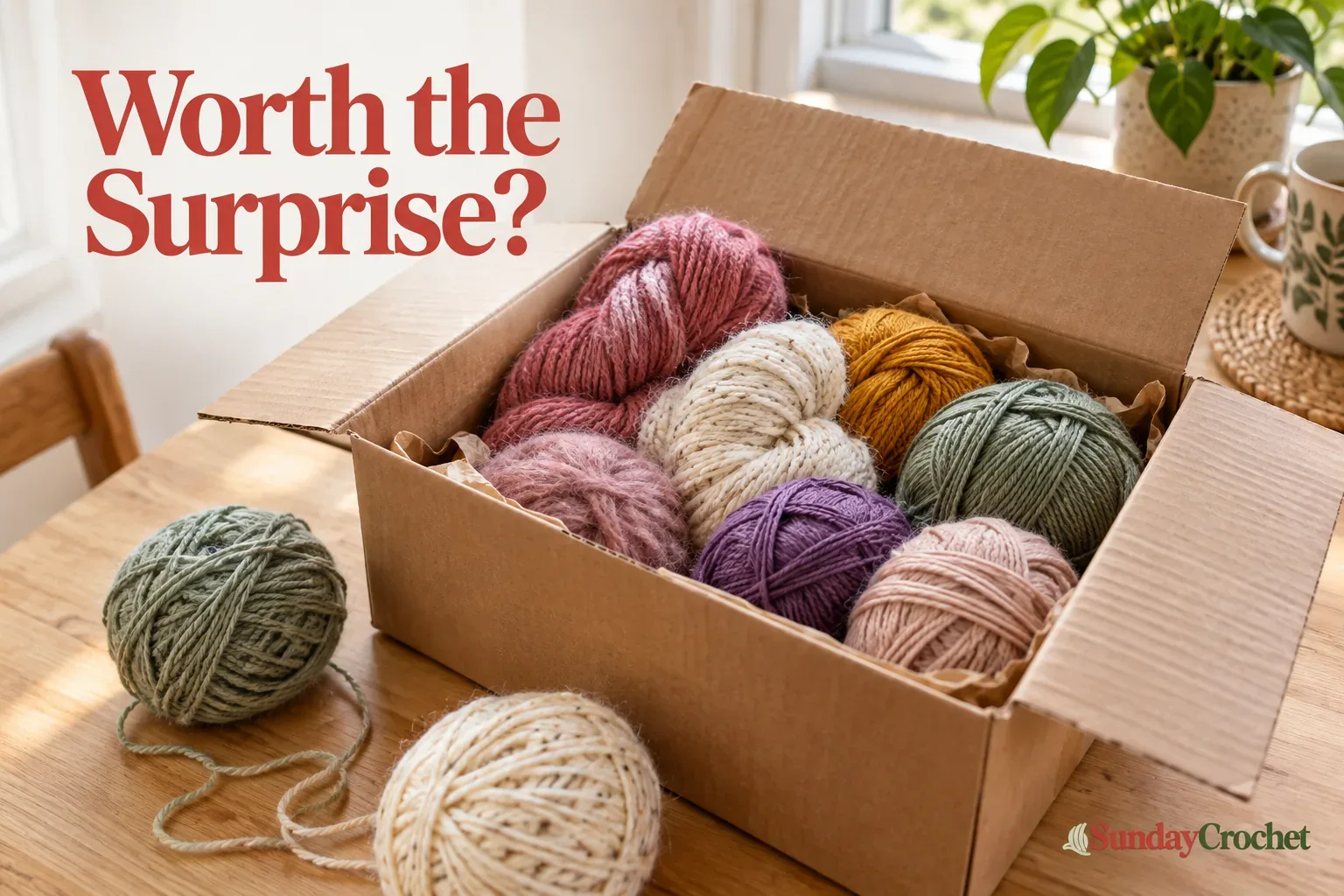
An unopened parcel of yarn has a particular kind of promise. Perhaps there is a color you would never have chosen, a beautiful new texture, or enough of something lovely to inspire your next project. A yarn mystery box sells that possibility along with its contents. For a few minutes, opening it can feel like receiving a present.
I understand the appeal. Crochet is a practical hobby, but it is also full of small pleasures: a satisfying stitch, a soft skein, a color that makes you smile. We do not need to justify every treat by proving it will become a finished blanket.
Still, when we ask whether yarn mystery boxes are worth it, the excitement of opening the parcel is only part of the answer. The other part comes later, when we try to make something with what arrived. My concern is the gap between a box that feels valuable and yarn that actually fits our lives.
I’ll show you how I think about that gap. The question I keep coming back to is simple: if these exact yarns were sitting on a shop shelf, would I choose them at this price?
The surprise is part of what you are paying for
With ordinary yarn shopping, you can look for the fiber, color, thickness, and quantity you want. With a mystery box, you give up some of those choices. The uncertainty is part of the product, and for someone who enjoys surprises, that can be a pleasure rather than a drawback.
That matters when talking about the word “scam.” A disappointing purchase does not, by itself, establish fraud. If a seller clearly offers unknown yarn and supplies what the listing promises, disliking the contents is a different issue from being deceived. Equally, the fact that a parcel contains yarn does not automatically make it a worthwhile purchase for you.
I prefer to separate those questions. Did the product match what was offered? And did what arrived give you something you value? The second question is where many mystery boxes can fall short, even when the first has a perfectly satisfactory answer.
There is nothing wrong with paying for a little excitement. But it helps to recognize that excitement as part of the cost. Otherwise, we can mistake the pleasure of receiving a parcel for evidence that we have saved money on our crochet.
Most projects begin with an idea, not a random skein
Think about the last thing you were excited to make. Perhaps the weather changed and you wanted a cardigan. Perhaps you had a gift in mind, or a flower pattern caught your attention. The project probably came with some requirements before you ever reached for a hook.
A soft wearable, a firm bag, and a small decorative motif do not ask the same things of their yarn. Even before choosing colors, you may have a preference for how the fabric feels, behaves, or needs to be washed. Buying yarn for that project gives those requirements a place in the decision.
A mystery box reverses the process. You receive the yarn first, then search for something it can become. That can be enjoyable if you like working from your stash and adapting ideas to the materials you have. It can be frustrating if your favorite part of crochet is choosing a particular project and making it just as you imagined.
Neither approach is more creative. They simply put the decisions in a different order. The trouble comes when a project-led crocheter buys a random assortment expecting it to replace the yarn they would otherwise buy deliberately.
The box may arrive, look lovely, and still leave the original project unfunded. You then buy the yarn you actually need as well. What seemed like an economical way to replenish your supplies becomes an extra purchase alongside the planned one.
Knowing the yarn weight does not tell you everything
Some mystery listings narrow the surprise by specifying a yarn weight. If you mostly crochet with DK, a DK assortment is more relevant than a completely unrestricted box. That information gives you a starting point, but it does not tell you how the yarn will feel or whether it suits your project.
Fiber content matters. So does the particular yarn's texture. You can appreciate the softness of a fiber in a finished item and still dislike working with it. Another crocheter might love the very same yarn. These preferences are personal, and discovering them is part of learning what you enjoy.
That is why “premium” or “beautiful” is not enough for me. A yarn can be well made, attractive, and unsuitable for the person who receives it. A box does not need to contain poor-quality yarn to be a poor match.
There are practical differences, too. Fiber affects stretch, drape, and the feel of the fabric, which is one reason we choose materials carefully. A matching thickness does not erase those differences. The label “DK” cannot tell you whether an assortment will make the fabric you had in mind.
When useful details are missing, you are accepting more than a surprise color. You may be accepting uncertainty about the basic material. That is quite a different purchase from choosing a yarn you already know you like, even if both options contain the same number of balls.
Colors and quantities can turn a bargain into shelf decoration
There is a difference between liking a color and wanting to crochet with it. A bright shade might look wonderful tucked into a collection, yet never suit the things you make or the people you make them for. An assortment can also contain several appealing colors that you simply do not want together.
Then there is quantity. One attractive ball may suggest a project without providing enough yarn to finish it. Several unrelated balls may add up to a substantial parcel while leaving you with very little of any single yarn.
Small amounts certainly have uses. They can suit small projects or details within a larger piece. But those uses need to appeal to you. “I could make something with this” is a much weaker reason to buy than “I want to make this, and this yarn fits.”
The details on a yarn label, including yardage, fiber content, and care instructions, help turn an attractive ball into a realistic project choice. When you cannot see those details before ordering, it is harder to know how much practical value the assortment has for you.
This is where the shop-shelf question becomes useful. Imagine the contents laid out individually. Would you pick up all of them, some of them, or only one? You do not have to know the exact contents to recognize that your usual preferences are quite specific.
Advertised value is different from money saved
Suppose a mystery bag costs $50 and is described as containing $75 worth of yarn. Those figures make the purchase sound like a $25 saving. But the saving only helps if the contents replace yarn you would have chosen and used.
If you had no reason to spend $75 on yarn, spending $50 has not automatically made you better off. You have spent $50 and received a parcel. Whether that was good value depends on what the parcel does for you, not just the larger number in the advertisement.
Even if the stated retail value is accurate, retail value and personal value are different. A skein you dislike can have a perfectly reasonable shop price while offering you very little enjoyment or use. Several such skeins do not become more useful because their prices add up neatly.
I find it helpful to think of value in three parts:
| Kind of value | What it means for a mystery box |
|---|---|
| Advertised value | The seller's stated value of the contents |
| Making value | How well the yarn fits projects you want to crochet |
| Enjoyment value | The pleasure of receiving, exploring, and owning the assortment |
All three can matter. The difficulty is letting the advertised value stand in for the other two. A box can score highly on surprise and poorly on making value. It can also be useful without feeling especially exciting. Naming the difference makes it easier to be honest about the purchase.
Why a seller's good deal may not be your good deal
A mystery assortment can introduce customers to yarns they would not normally try. That is a reasonable appeal: sometimes an unfamiliar material becomes a favorite. There is room for discovery in crochet, and choosing only familiar yarn can feel limiting.
An assortment can also be a way to move stock that has not sold individually. Overstock, less popular shades, or remaining quantities can all have a place in a clearance-style offering. That possibility does not prove that any particular seller is doing something wrong, or that the yarn is defective.
What matters is that the seller's reason for grouping the yarn may be different from your reason for buying it. A parcel can solve a stock problem for a business without solving a materials problem for you. Both sides can receive something from the transaction, but the benefits are not necessarily equal.
I would be wary of assuming that a mystery box has been selected around my tastes simply because its presentation feels personal. Unless the offer explains what has been chosen and why, the warm feeling of receiving a gift can disguise a fairly ordinary sale of unknown goods.
The next box can be more tempting than using the last one
The opening is quick. Crocheting through the contents takes longer. That difference is easy to overlook when another surprise assortment appears and promises the same little burst of pleasure.
You do not need to have a huge stash for this to matter. A few purchases that never find a purpose can occupy the space you need for materials you actively use. They can also take up the portion of your budget that would have bought the right yarn for a project you were ready to start.
I am not interested in judging anyone's shelves. A collection can bring pleasure, and a full shelf does not tell an outsider how often its contents are used. The more useful question is what happens to your own yarn after the parcel is opened.
Does it become fabric? Does it inspire a project you are happy to make? Or does it wait while the next purchase supplies the excitement? If the opening is consistently the best part, you may be buying an experience more than replenishing your working materials.
That is a reason to pause and be honest, rather than a reason to feel guilty. The limits are ordinary ones: money, space, and how much crochet you actually want to do.
There are other ways to enjoy unfamiliar yarn
A yarn swap can offer discovery with more choice. You can see what another person has available, talk about the materials, and exchange yarn that is sitting unused. The surprise may be smaller, but the chance of finding something that suits you can feel more concrete.
Secondhand yarn can also be worth considering when you can inspect the contents or understand what is included. Buying someone else's unused supplies still requires judgment about fiber, quantity, and condition. It does, however, give existing yarn another opportunity to become something useful.
And sometimes the most satisfying discovery is on your own shelf. Looking at what you already have and choosing a project around it asks a different kind of creativity from ordering another parcel. It can reveal that you have enough possibilities waiting without adding more.
These options will not reproduce every part of the mystery-box experience. An unexpected parcel has its own appeal. But if the aim is to explore new materials while avoiding more unused yarn, the amount of choice you retain matters.
A box is worth it when the contents have a place in your life
I would not call every yarn mystery box a bad purchase. Someone with broad fiber preferences, a love of small projects, and a habit of using mixed assortments may enjoy one and work through it happily. For that person, the uncertainty can be part of the creative pleasure.
My hesitation is with treating the same product as an obvious saving for everyone. If you choose projects carefully, dislike particular textures, or need a specific quantity and color, surprise yarn can work against the way you crochet. The bigger advertised value does not remove that mismatch.
The most revealing evidence is what happens after the excitement settles. A box that becomes projects, experiments, or yarn you enjoy using has offered something real. A box that stays untouched while you buy more materials has probably cost more than its promising presentation suggested.
You can love yarn, enjoy surprises, and still leave a mystery box unbought. The next satisfying purchase might be one deliberately chosen skein with a clear purpose. There is a quiet pleasure in that, too: knowing what you want to make, knowing why the yarn fits, and looking forward to the stitches rather than only the parcel.